Skip to content


 Vertical Blinds
 Roman Blinds
 Roller Blinds
 Venetian Blinds
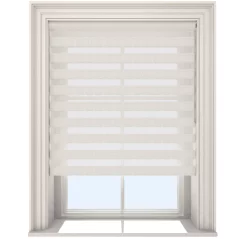 Day and Night Blinds
 Skylight Blinds
 Children
 Wooden Blinds
 Curtains
 Blinds Accessories
 White
White Yellow
 Gold
Gold Green
Green Grey
Grey Pink
Pink Orange
 Animal
 Floral
 Geometric
 Striped
 Motorized Day and Night Blinds
 Motorized Roller Blinds
 No Drill Rollers
 Perfect Fit Wooden
 Perfect Fit Metal
 Thermal Blinds
 Better Sleep Blinds
 Cordless Blinds
 No Drill Blinds
 Blackout Blinds
 Waterproof Blinds
 Easy Wipe Blinds
 Taped Blinds
 Conservatory
 Office
 Kitchen
 Bathroom
 Dining Room
 Kids Room
 Living Room
 Bedroom
 Bay Window
 Conservatory Window
 Tild and Turn Window
 Bi Fold Window
 Roof of Skylight
 French Door
 Sliding Door
Day and Night Blackout Blinds: What the Dim-Out Layer Actually Blocks
- by Mariam Labadze
Day and night blackout blinds dim a room, they do not black it out. The fabric is two layers of alternating opaque and sheer bands on one roller, and when you line the opaque bands up you get a deep shade with light still passing between them.
That is not a flaw in the product. It is how the fabric is built, and knowing it in advance is the difference between loving these blinds and returning them.
Key Takeaways
-
Two layers, one roller. Opaque and sheer bands run across both layers, and the roller slides one past the other.
-
Dim-out, not blackout. Even fully aligned, day and night blackout blinds pass light where the bands meet.
-
Edges leak as usual. A recess fit leaves the same gap at the sides that every roller leaves.
-
The view is the point. Half-open, these give privacy and daylight together, which no blackout blind does.
-
Buy a blackout roller for sleep. If somebody has to sleep past sunrise, this is the wrong fabric.
What Day and Night Blackout Blinds Actually Are
Picture a single piece of fabric printed in horizontal stripes, opaque then sheer, then folded back on itself so there are two layers hanging from the same tube. Turning the chain slides the front layer against the back one. Line up the two opaque stripes and the window shades over. Offset them so an opaque band sits against a sheer one and you get a striped view out.
This is the same construction sold as zebra blinds and as vision blinds, which is worth knowing when you are comparing prices across sites. Across the day and night blinds range the mechanism is identical whatever the name on the label. What changes between products is the fabric weight, the width of the bands, and whether the opaque stripe is a true blockout or a heavy dim-out.
Dim-Out and Blackout Are Not the Same Thing
A blackout fabric has a coating or a bonded backing that light cannot pass through. A dim-out fabric is simply dense. Most day and night blackout blinds use a dense opaque band rather than a coated one, because a coated stripe is stiff and would not roll cleanly against the second layer.
So even with the bands perfectly aligned, you are looking at a deep grey rather than a black. On a bright June morning that reads as a shaded room, not a dark one. People buying day and night roller blinds for a bedroom are usually surprised by this, and nobody mentions it on a product page because the photographs are all taken at dusk.
Where the Light Gets In
Three places, and only one of them is the fabric. Work through them before you order, because two are fixable at the fitting stage and one is not.
The band joins are the first. Even aligned, the two layers are a millimetre or two apart and never perfectly registered across a wide blind, so a faint line runs along each seam. Second, the roller gap at the top, where the tube sits below the head of the reveal and leaves a strip of glass exposed. Third, the side edges, because any blind fitted inside a recess is cut narrower than the opening so it can travel. That last one is not specific to zebra blinds at all, it is the same gap on every roller blinds fitting.
Mounting outside the recess with a generous overlap deals with the sides and most of the roller gap, and costs nothing extra. The band joins stay. If you want every edge closed, the honest answer is a different product: a honeycomb blackout blind running in side channels seals what day and night blackout blinds cannot, and gives up the view entirely in exchange.
Day and Night Blackout Blinds Against a Plain Blackout Roller
Set them side by side and the choice is obvious once you name what each one is for.
A plain blackout roller blinds fabric is one layer, coated, and it has exactly two positions: up or down. Down, it is as dark as a single blind gets. Up, you have a bare window. There is no middle.
Day and night blackout blinds give you the middle. Three quarters of the way through the chain travel you have privacy from the street and full daylight in the room, which is the setting most people leave them on all day. Complete blackout blinds cannot do that, and that is the whole trade. You are buying daytime flexibility and paying for it in night-time darkness.
Price tends to follow the same line. Day and night roller blinds usually sit above a plain roller of the same width, because there is twice the fabric and a heavier tube, and below complete blackout blinds in a sealed frame.
Rooms Where the Dual-Band Fabric Wins
Living rooms, dining rooms and home offices, where glare on a screen is the problem and sleeping is not. A north-facing bedroom used by an adult who wakes at seven is fine. A nursery, a shift worker's room or any east-facing bedroom in summer is not, and no amount of fabric upgrade changes it.
Fitting is the easy part. Day and night blackout blinds go up like any roller, and no drill blinds versions clip into a uPVC frame without screws, which is why no drill day and night blinds sell so well to renters. Most zebra blinds uk suppliers offer the same clip-in option, so compare on fabric rather than on fitting. If you are deciding between no drill day and night blinds and a drilled fixing, the clip-in version loses nothing in darkness, since the band joins limit it either way.
Buy day and night blackout blinds for the room you sit in during the day. Buy a coated blackout roller blinds fabric for the room you sleep in.
Frequently asked questions
How do day and night blinds work?
Two layers of striped fabric hang from one roller, each printed with alternating opaque and sheer bands. Turning the chain slides the front layer against the back one. When the opaque bands align, the window shades over. When an opaque band sits behind a sheer one, light comes through in stripes. It is one continuous movement, so you can stop anywhere between the two.
Can you see through day and night blinds?
Out, yes, when the bands are offset. In, mostly not during daylight, because the brighter side is outside. After dark that reverses: with a light on indoors, somebody outside can see shapes through the sheer bands. For night-time privacy you need the opaque bands aligned, which is also the position that makes the room darkest.
Are day and night blinds blackout?
No. The opaque stripe is usually a dense dim-out fabric rather than a coated blackout one, and light still passes at the band joins, at the roller gap and round the sides. Aligned, they give a deep shade that suits a living room. For a bedroom where somebody has to sleep past sunrise, a coated blackout fabric is the right choice.