Skip to content


 Vertical Blinds
 Roman Blinds
 Roller Blinds
 Venetian Blinds
 Day and Night Blinds
 Skylight Blinds
 Children
 Wooden Blinds
 Curtains
 Blinds Accessories
 White
White Yellow
 Gold
Gold Green
Green Grey
Grey Pink
Pink Orange
 Animal
 Floral
 Geometric
 Striped
 Motorized Day and Night Blinds
 Motorized Roller Blinds
 No Drill Rollers
 Perfect Fit Wooden
 Perfect Fit Metal
 Thermal Blinds
 Better Sleep Blinds
 Cordless Blinds
 No Drill Blinds
 Blackout Blinds
 Waterproof Blinds
 Easy Wipe Blinds
 Taped Blinds
 Conservatory
 Office
 Kitchen
 Bathroom
 Dining Room
 Kids Room
 Living Room
 Bedroom
 Bay Window
 Conservatory Window
 Tild and Turn Window
 Bi Fold Window
 Roof of Skylight
 French Door
 Sliding Door
Blackout Blinds for Windows: Which Type Suits Which Window
- by Mariam Labadze
Blackout blinds for windows are decided by the shape of the opening, not by the darkness of the fabric. Almost every blackout fabric blocks light in the middle of the blind. What separates a genuinely dark room from a disappointing one is whether that blind can close the edges of your particular window.
So sort blackout blinds for windows by the opening, not the product. Find yours below, and read the last line of each section, where the wrong blind for it gets named.
Key Takeaways
-
Shape decides, fabric follows. Blackout blinds for windows all block light centrally, and differ only in how they handle the perimeter.
-
The side gap is designed in. A recess fit is cut narrower than the opening so it can travel, which is why light runs down both edges.
-
A bay is three windows. Blackout blinds for windows in a bay add two vertical edges per blind.
-
Roof windows need holding down. Fabric hanging at an angle pulls away from the glass unless side channels hold it there.
-
Width has a ceiling. Past a certain span one blind becomes two, and the join between them is the new leak.
Why the Window Decides, Not the Fabric
Hold a blackout sample against a bright window and you see nothing through it. Every coated fabric passes that test, which is exactly why comparing swatches tells you so little.
Light does not come through the fabric. It comes round it: over the roller, down the two sides where the blind is narrower than the reveal, and under the bottom rail. How wide those gaps are depends on the opening, not the cloth. How deep the reveal is, whether it is square, whether there is flat wall to overlap on to, whether anything can hold the fabric against the frame.
That is why the blackout blinds for windows worth your money depend on the room you are standing in. A deep square reveal in a modern house forgives nearly any fitting. A Victorian opening that is a centimetre out of square at the top forgives nothing, and no fabric upgrade changes that.
Made to measure blackout blinds matter for the same reason. They are not darker. They are cut to the opening you actually have, which is the half of the problem fabric cannot touch.
Blackout Blinds for Windows in a Standard Recess
The easy case. A square reveal with enough depth takes a roller inside the recess, and the whole thing looks built in.
Here is the catch nobody puts on a product page. Blackout blinds for windows fitted inside a recess are made narrower than the opening so the fabric clears the plaster, so a strip of bare glass stays uncovered down each side whatever you do. In a living room you will never notice. In a bedroom at five in the morning in June, you will.
The fix is free and most people skip it: fit outside the recess instead. Bring the blind wider than the opening on both sides and longer at the bottom, and the side leak closes to almost nothing. It looks slightly heavier on the wall. It is the single biggest improvement available on a flat window, and it costs the same.
For blackout blinds for bedroom windows, that overlap is worth more than any upgrade in the fabric list. Plain blackout roller blinds fitted outside the recess beat a premium fabric fitted tight inside it, every time.
Wrong blind for this window: a venetian. Slats leak light at every joint even closed flat, and in a recess you get the side gaps as well.
Bays and Out-of-Square Reveals
A bay is where blackout blinds for windows start getting difficult. Three panes means three blinds, and three blinds means two extra vertical joins on top of the usual side gaps. Because the panes meet at an angle, those joins are never flush. One blind sits a few millimetres proud of its neighbour and the light runs straight down the step.
Overlapping helps, but you can only overlap in one direction, so you are choosing which join is tidy and which is dark. A curtain across the whole bay on a bent track is the other route, and it is darker by a distance.
Out-of-square reveals are the same problem without the angles. Older houses settle, and a reveal that measures a couple of centimetres wider at the top than at the bottom will show a wedge of light down one side of any square blind. Measure in three places, use the smallest for a recess fit, and if the difference is more than a centimetre or so, fit outside the recess and stop fighting it.
The bay window blinds range handles the shape. Darkness in a bay is a separate battle, and it is usually won with overlap and a curtain rather than with fabric.
Wrong blind for this window: one wide blind spanning the whole bay on a straight track. It will foul the side panes before it is halfway down.
Roof Windows and Skylights
Gravity is the problem. On a vertical window the fabric hangs flat against the glass. On a sloping roof window it sags away from the frame, and the moment there is a gap between fabric and glass, light gets behind the blind and fills the room with a grey glow.
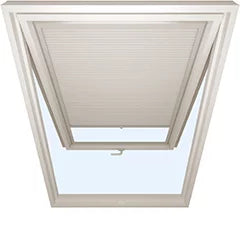
So blackout blinds for windows in a roof only work when the fabric is held at both edges. skylight blinds run in side channels fixed to the window frame, with the fabric tensioned between them, which is also why they are sold by the specific window model rather than by the centimetre. Blackout blinds with frame systems like these are the one place in the whole category where the frame is doing more work than the fabric.
Check the model number stamped on the window before you order anything. Velux and similar roof windows use their own sizing codes, and compatibility is by code, not by tape measure.
Wrong blind for this window: anything hanging from a roller with free sides. It will bow in the middle within a week and let in more light than it stops.
Patio Doors and Very Wide Openings
Here the enemy is weight. A single roller spanning a wide patio door becomes heavy enough that the tube deflects in the middle, so the fabric no longer sits parallel to the glass and the bottom rail stops hanging level. Beyond a certain width, suppliers split the opening into two or three blinds, and every split is a new vertical light gap.
Verticals are the traditional answer for patio door blinds, and they are the right answer for glare, privacy and keeping one half of the door usable. For darkness they are the weakest type in the category, because light passes between every louvre no matter how tightly you close them.
Complete blackout blinds across an opening that wide usually means accepting a join and placing it where the door handle already breaks the line. If the room is a bedroom and the doors face east, that compromise is not good enough, and the honest answer is a curtain on a track outside the opening.
Where sealed edges really are the answer, a honeycomb blackout blind running in side channels closes what a loose roller cannot, which is why it keeps coming up for bedrooms, nurseries and roof windows. It costs more and gives up the simplicity of a roller in exchange.
Pick blackout blinds for windows by the opening first, then by the fitting, then by the fabric. That order is the whole article.
Wrong blind for this window: a single roller stretched across the full width. Split it, or curtain it.
Frequently asked questions
What are blackout roller blinds?
A single layer of fabric on a tube, coated or backed so light cannot pass through it. They are the most common of the blackout blinds for windows because a roller is simple, tidy in a recess and easy to make in odd sizes. The coating is what makes them blackout. An uncoated dim-out roller in the same colour looks almost identical in a product photograph and is noticeably lighter once it is on your wall.
Which blinds are best for blackout?
The ones held at the edges. A blind running in side channels fixed to the frame closes the two side gaps that every recess-mounted blind leaves open, which is why channel systems win on roof windows and in nurseries. After that, a roller fitted outside the recess with a generous overlap, then a plain roller inside the recess. Venetians and shutters are not really in this conversation, because slats leak at every joint.
How do you fit blackout blinds?
Two decisions before you pick up a drill. Inside the recess looks neater and leaks down both sides. Outside the recess, with the blind wider and longer than the opening, is darker, and it is the only free improvement on offer. On uPVC, clip-in brackets avoid drilling altogether, which is what renters usually need. Measure the width in three places and use the smallest for a recess fit, the largest plus your overlap for an outside fit.