Skip to content


 Vertical Blinds
 Roman Blinds
 Roller Blinds
 Venetian Blinds
 Day and Night Blinds
 Skylight Blinds
 Children
 Wooden Blinds
 Curtains
 Blinds Accessories
 White
 Yellow
 Gold
 Green
 Grey
 Pink
 Orange
 Animal
 Floral
 Geometric
 Striped
 Motorized Day and Night Blinds
 Motorized Roller Blinds
 No Drill Rollers
 Perfect Fit Wooden
 Perfect Fit Metal
 Easy Stick Honeycomb
 Easy Stick Wooden
 Easy Stick Metal
 Thermal Blinds
 Better Sleep Blinds
 Cordless Blinds
 No Drill Blinds
 Blackout Blinds
 Waterproof Blinds
 Easy Wipe Blinds
 Taped Blinds
 Conservatory
 Office
 Kitchen
 Bathroom
 Dining Room
 Kids Room
 Living Room
 Bedroom
 Bay Window
 Conservatory Window
 Tild and Turn Window
 Bi Fold Window
 Roof of Skylight
 French Door
 Sliding Door
Twist and Fit Blinds: How a Bracket Grips Without a Single Screw
- by Mariam Labadze
Twist and fit blinds hold on by friction and nothing else. A bracket at each end of the headrail expands outwards as you turn it, pressing hard against two opposite faces of the recess, and that pressure is the only thing keeping the blind on the wall. No screws, no adhesive, no part of the window frame involved.
Whether it works comes down to two things you can check with a tape measure: how deep the recess is, and how square. Get either wrong and the blind does not fall off dramatically; it creeps down one side over a fortnight.
Key Takeaways
-
Friction does all the work. Two pads press against opposite faces of the recess, and no fixing enters the wall.
-
Depth decides it first. A shallow reveal leaves part of the pad bearing on a plaster edge, which crumbles.
-
Square matters as much as depth. A splayed or bowed reveal means the pads touch at a corner rather than flat.
-
Weight is the ceiling, not width. A wide light fabric asks less of the clamp than a narrow lined one.
-
Removal is the real prize. Twist and fit blinds come out in a minute and leave the wall as you found it.
What Twist and Fit Blinds Actually Clamp Onto
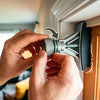
Take the headrail out of the box and look at the ends. Each bracket carries a pad on a threaded barrel, and turning the end winds that pad outwards. The two pads travel in opposite directions, the headrail is trapped between them, and the blind is up.
What they push against varies between systems. Most bear on the two side reveals, left wall and right wall. Some clamp front to back, between the window frame and the face of the opening. Which design you have changes which measurement matters, so read the instructions first.
The hold is friction in every case. Clamping force comes from how far the pads have been wound out, and resistance from whatever surface they land on. Sound plaster grips well. Gloss paint grips less. Tile grips least, and that ranking explains most of the complaints you will read.
Because the wall carries everything, twist and fit blinds are specified by recess size rather than by window type. The frame material is irrelevant. The reveal is the whole story.
One thing worth clearing up. Search perfect fit blinds uk and the results show a frame that clips around the glazing unit, a completely different idea from this bracket. The two get confused because both are sold as no drill, and twist and fit blinds are the ones that never touch the window.
The Recess Depth That Makes or Breaks It
Depth is the first check and the one most people skip. Measure from the face of the wall back to the window frame at the top of the opening, and take that measurement at both ends, because in an older house it is rarely the same.
You need enough depth for the whole headrail to sit inside the reveal with the brackets engaged. If part of the rail stands proud, a share of the clamping load lands on the plaster edge rather than the flat of the reveal, and a plaster edge gives way under point loading. That is the commonest way twist and fit blinds fail early.
Square is the second check, and it needs more than one measurement. Run a tape across the opening at the top, the middle and the bottom. Different widths mean a splayed reveal, which puts each pad in contact at one edge instead of across its face and cuts the grip to a fraction of what the bracket was designed for.
Bowed reveals are commoner than anyone expects and harder to spot. Hold a straight edge against the side wall of the recess and look for daylight behind it.
Surface matters as much as geometry. Cured plaster and emulsion are fine. Wallpaper is not: the pad grips the paper and the paper lets go of the wall. Tiles are slippery, and a clamp loaded across a tile edge can crack it.
Weight Is the Limit, Not Width
The question people ask is how wide a blind the brackets will carry, and it is the wrong question. Width adds load gradually. Weight adds it immediately, and weight comes from the cloth rather than the dimensions.
A light screen fabric on a broad window asks less of a clamp than a narrow blind in heavy lined cloth. Fabric choice stops being a decorating decision and becomes part of the fitting.
Blackout is where it bites hardest. A coated blackout cloth is appreciably heavier than a plain dim-out, and wound onto a tube that weight hangs entirely from the headrail. Standard roller blinds in a blackout fabric sit at the top end of what a friction bracket should carry, especially on a tall drop.
There are ways around it. Perfect fit roller blinds move the same fabric onto the window frame, so the load never reaches the wall, and perfect fit blackout blinds do the same with a darker cloth. Fitted blackout blinds, screwed into the reveal, avoid the problem altogether. For a genuinely dark bedroom, channelled blackout blinds beat any clamped fitting, because the clamp caps the fabric weight and the fabric caps the darkness.
Operation adds load too. A side chain yanked rather than pulled sends a sharp downward jerk through the headrail, exactly the force a friction bracket resists worst. Twist and fit blinds in a child's bedroom slip for that reason, not because the fabric was heavy.
Taking Them Down and Moving Them
This is where the fitting earns its keep. Reverse the twist, the pads retract, the headrail lifts straight out, and the reveal is exactly as it was. No filler, no touching up paint, no awkward conversation at the end of a tenancy.
It also makes twist and fit blinds portable in a way screwed brackets are not. A blind sized for one recess will go into another of similar width, since the brackets carry a little adjustment, though not much.
Take them down occasionally even if nothing seems wrong. Pads compress, plaster dust builds up, and a bracket that felt solid in spring is often loose by autumn. Wipe both pads and the reveal, refit, and wind the brackets out until they bite.
Use a spirit level every time you refit. A crooked headrail clamps at a point rather than across the pad, and twist and fit blinds set crooked are the ones that walk down the wall.
Windows Where This Fitting Will Not Hold
Some windows simply refuse, and spotting yours early saves you a return.
Shallow recesses are the clearest case. Where the frame sits close to the face of the wall there is nowhere for the headrail to live, and no amount of winding fixes that.
Face fitting is out by definition. On a flat wall above an opening there is no second surface to push against, so twist and fit blinds have nothing to clamp. The same goes for a window with no reveal at all.
Tiled bathrooms and splashback recesses are a judgement call rather than a flat no. The grip is poor, the crack risk is real, and a steamy room loosens things over time.
Bay windows with angled returns cause trouble at the corners, where the two faces a bracket needs are not parallel. Tilt and turn casements rule it out differently: anything in the reveal fouls the leaf when it swings in, which is where perfect fit blinds come into their own, since they travel with the sash.
Run three checks before you order. Depth at both ends, width at top, middle and bottom, and an honest look at what the reveal is made of. Twist and fit blinds reward a sound, square recess and punish a rough one, and a tape measure tells you which you own.
Frequently asked questions
How do no drill blinds work?
They transfer the blind's weight into something that already exists. A twist bracket expands against two opposite faces of a recess and holds by friction alone, so the load runs into the plaster instead of into a fixing. Nothing enters the wall, which is why the grip depends entirely on how flat, how square and how sound those two surfaces are.
What are no drill blinds?
Standard blinds supplied with a bracket that needs no fixing. The fabric, the tube and the control side match the drilled version, and only the mounting changes. Twist and fit blinds are the clamped type, which means your recess rather than your window frame decides whether they suit you, and fabric weight decides how long they stay put.
How do you fit blinds?
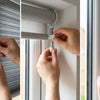
Measure the recess depth at both ends and the width at the top, the middle and the bottom before anything else. Set the headrail into the opening, hold it level, then wind each bracket out until both pads bite. Check the level again, because tightening one end usually lifts the other, and load the fabric only once both ends feel solid.