Skip to content


 Vertical Blinds
 Roman Blinds
 Roller Blinds
 Venetian Blinds
 Day and Night Blinds
 Skylight Blinds
 Children
 Wooden Blinds
 Curtains
 Blinds Accessories
 White
White Yellow
 Gold
Gold Green
Green Grey
Grey Pink
Pink Orange
 Animal
 Floral
 Geometric
 Striped
 Motorized Day and Night Blinds
 Motorized Roller Blinds
 No Drill Rollers
 Perfect Fit Wooden
 Perfect Fit Metal
 Thermal Blinds
 Better Sleep Blinds
 Cordless Blinds
 No Drill Blinds
 Blackout Blinds
 Waterproof Blinds
 Easy Wipe Blinds
 Taped Blinds
 Conservatory
 Office
 Kitchen
 Bathroom
 Dining Room
 Kids Room
 Living Room
 Bedroom
 Bay Window
 Conservatory Window
 Tild and Turn Window
 Bi Fold Window
 Roof of Skylight
 French Door
 Sliding Door
Flat Roof Skylight Blinds: Fitting Options for Roof Lanterns and Windows
- by Mariam Labadze
 Yes, you can absolutely get blinds for flat roof skylights, and they fit either inside the frame of the skylight itself or across the underside of a roof lantern using a tensioned or guided system that holds the fabric flat against gravity. Flat roof skylight blinds tame glare, cut solar heat and, in blackout form, darken a room that would otherwise flood with sky.
Overhead glass is brilliant for daylight and hopeless for control if left bare. A flat rooflight or a pitched roof lantern sits above your head, so an ordinary hanging blind is useless. The fabric has to be held taut and level, which is exactly what a purpose-made system does. Below I will walk through the fitting options, the difference between manual and electric, and how to darken these tricky spaces properly.
[toc]
Can you get blinds for flat roof skylights?
You can, and there is more choice than most homeowners expect. The category of skylight blinds covers flat, glazed rooflights set into a flat roof, pitched roof windows like the branded units many extensions use, and the multi-facet glass of a roof lantern. Each has a slightly different fitting approach, but all share one requirement: the blind must resist sag and stay flat when it is nowhere near vertical.
For flat rooflights, the usual solution is a blind that runs in side channels or on a tensioned guide, so the fabric pulls flat across the opening rather than drooping. A dedicated range of skylight blinds is engineered for exactly this, with the springs, cassettes or wires needed to hold everything level. It is worth stressing that a standard roller blind meant for a wall window will not do the job overhead; the mechanism is not built to fight gravity.
How flat roof skylight blinds fit
Inside the frame
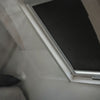
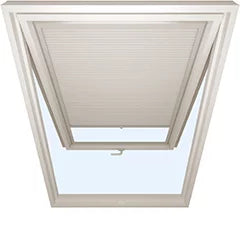
The neatest option is to fit the blind inside the skylight frame. The fabric is held between two side rails or guide wires so it stays taut, and a cassette at one end conceals the roll. This gives a clean, integrated look and sits close to the glass, which helps with both heat and light. For branded roof windows there are made-to-measure kits sized to the exact model, so the fit is snug and the fabric tracks smoothly.
Measuring here has to be precise. You are working to the internal dimensions of the frame, and even a small error leaves a light gap at the edge. If your rooflight is a known branded size, matching the blind to that reference makes life easier. For a bespoke or builder-installed flat rooflight, careful measurement of the aperture, ideally checked twice, keeps the tension right.
Under a roof lantern
A roof lantern is a raised, multi-sided glass structure, so blinds fit differently. One approach is an individual blind on each pane or facet, following the pitch of the glass. Another is a single blind drawn across the underside of the lantern at ceiling level, spanning the opening below the glass rather than following its shape. The first hugs the glass and looks architectural; the second is simpler and often more practical for a large lantern.
Because lanterns are almost always well out of reach, this is where motorised operation stops being a luxury and becomes the sensible default. Reaching a pole up to a lantern several metres overhead is awkward at best. A set of motorised blinds driven by remote or app control makes daily use realistic, and you can group multiple facets to move together.
Conservatory and lean-to roofs
The same principles carry over to glazed conservatory and lean-to roofs, which sit somewhere between a rooflight and a lantern. Pitched runs of glass need blinds that follow the slope and stay tensioned along their length. If your project is a glass-roofed room rather than a single skylight, the conservatory blinds range is designed for those larger, angled expanses and the heat build-up that comes with them.
Getting the room properly dark
Overhead glass is the hardest place to achieve true darkness, because any gap at the edge lets a bright line of sky straight in. If you want a bedroom, nursery or media room genuinely dark, you need a blind that runs in side channels and sits tight to the frame, paired with a dense fabric. This is why blackout is such a common request for roof glass; a translucent fabric will dim the room but never black it out.
For the darkest result, choose a blackout fabric held in guided rails rather than a free-hanging one. A well-fitted skylight blind in a solid weave blocks the bulk of the light, and a full range of blackout blinds covers both roof and wall windows so you can match a room throughout. Bear in mind that no overhead blind is perfectly light-tight at every edge, so manage expectations: excellent darkening is realistic, absolute pitch black at every seam is not.
Heat, glare and comfort
Beyond darkness, the everyday value of flat roof skylight blinds is comfort. Uncovered roof glass can turn a room stifling in summer and let heat escape in winter. A blind adds a layer that reflects or absorbs some solar gain in the warmer months and provides a little insulation in the colder ones. Lighter, reflective fabrics tend to be best for heat control on a sun-facing roof, while a denser fabric leans towards privacy and darkening.
Glare is the other daily nuisance, especially if you have a screen below the glass. Even a translucent skylight blind takes the harsh edge off midday light without shutting the room down, which is often all a kitchen or home office needs. Match the fabric to the job: cooling and glare control point you one way, blackout points you another.
Manual or electric?
Manual skylight blinds are operated by a pole, a side crank or a pull system, and they are perfectly fine for a low, reachable rooflight. The moment the glass is high or angled, though, reaching it becomes a chore, and a chore blind is a blind you leave shut or open all season. That is the practical case for electric.
Electric skylight blinds run on a small motor, powered by a rechargeable battery or wired in, and operate by remote, wall switch or smart home control. For a roof lantern, a run of high rooflights, or a conservatory roof, they are usually the better long-term choice because you will actually use them. Battery versions avoid running cables, while wired versions suit new builds and renovations where the supply can be planned in. Weigh the convenience against the extra cost and decide based on how reachable your glass really is.
Frequently asked questions
Can you get blinds for flat roof skylights?
Yes. Flat rooflights, branded roof windows and roof lanterns can all take purpose-made skylight blinds. The key is a system that holds the fabric flat against gravity using side channels, guide wires or a tensioned mechanism, rather than an ordinary hanging blind. Both manual and electric versions are available, and many are made to measure for a snug fit.
How do flat roof skylight blinds fit?
They fit either inside the skylight frame, where the fabric runs between side rails and a cassette conceals the roll, or across the underside of a roof lantern at ceiling level. Branded roof windows have made-to-measure kits sized to the model. Accurate measurement of the internal frame is essential, because even a small gap at the edge lets light in.
Are electric skylight blinds better?
For high or angled glass, yes, because you can actually reach and use them by remote or app, whereas a pole-operated blind on a distant lantern often gets neglected. For a low, easily reached rooflight, manual is perfectly adequate and costs less. Battery-powered motors avoid wiring, while hard-wired versions suit new builds and major renovations.