Skip to content


 Vertical Blinds
 Roman Blinds
 Roller Blinds
 Venetian Blinds
 Day and Night Blinds
 Skylight Blinds
 Children
 Wooden Blinds
 Curtains
 Blinds Accessories
 White
White Yellow
 Gold
Gold Green
Green Grey
Grey Pink
Pink Orange
 Animal
 Floral
 Geometric
 Striped
 Motorized Day and Night Blinds
 Motorized Roller Blinds
 No Drill Rollers
 Perfect Fit Wooden
 Perfect Fit Metal
 Thermal Blinds
 Better Sleep Blinds
 Cordless Blinds
 No Drill Blinds
 Blackout Blinds
 Waterproof Blinds
 Easy Wipe Blinds
 Taped Blinds
 Conservatory
 Office
 Kitchen
 Bathroom
 Dining Room
 Kids Room
 Living Room
 Bedroom
 Bay Window
 Conservatory Window
 Tild and Turn Window
 Bi Fold Window
 Roof of Skylight
 French Door
 Sliding Door
Thermal Vertical Blinds: Keeping Heat In Across a Wide Window
- by Mariam Labadze
 Thermal vertical blinds are the honest trade-off for a wide window: they will never insulate as well as a cellular shade, because there is a small gap between every louvre, but they are the only thermal option that covers a three-metre patio door in one continuous run. If your priority is spanning a big opening while cutting draughts, they earn their place.
[toc]
That is the fair way to frame them, not as the warmest blind you can buy, but as the warmest blind that fits a very wide window. Below is where thermal vertical blinds genuinely help, where they fall short, and how to get the most warmth out of a design that has gaps built in.
Key Takeaways
-
Gaps are the weakness: thermal vertical blinds lose some heat between louvres, so they trail a sealed cellular shade on pure insulation.
-
Width is the strength: they cover a three-metre patio door in one run where a cellular shade would need splitting.
-
Overlap matters: wider louvres and a snug fit reduce the gaps and lift the thermal performance noticeably.
-
Fabric does the work: a dense, lined louvre holds far more heat than a thin one, so specify the fabric carefully.
-
Pair for warmth: curtains or a pelmet over the top close the gap that the louvres alone cannot.
The honest weakness: gaps between louvres
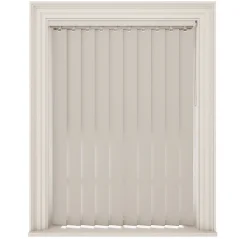
A vertical blind is made of separate fabric louvres that hang side by side and rotate to control light. That design is brilliant for a wide window, but it means the blind is never a single sealed surface. Warm air finds the vertical gaps where one louvre meets the next, and some of it slips through to the cold glass behind.
A cellular, or honeycomb, shade has no such gaps. Its folded cells trap a layer of still air across the whole window, which is why it beats a vertical blind on insulation every time. Pretending otherwise would not help you choose well.
So if the window is small and warmth is everything, a cellular shade is the better buy. The vertical blind only comes into its own when the window gets too wide for anything sealed to cover in one piece.
The strength nothing else matches: covering a wide run
Here is where thermal vertical blinds win outright. A three-metre patio door or a wide bay defeats most blind types, which either cannot be made that wide or have to be split into separate units with cold seams between them. A vertical blind runs the full width on a single track and draws to one side like a curtain.
That continuous coverage is worth real warmth. A single run with no join means no gap where two blinds meet, and the louvres can be drawn fully across to put a complete fabric layer in front of the glass. For patio doors specifically, the patio door blind range is built around this ability to span and stack out of the way of the door.
It is also the practical choice for daily use. You walk through a patio door constantly, and vertical louvres part and swing back far more gracefully than a stack of horizontal slats on that kind of opening.
How louvre width and overlap change the numbers
Not all vertical blinds gap the same amount. Wider louvres mean fewer joins across the window, and a blind specified with a generous overlap sits the louvres closer together when closed, which shrinks the cold channels between them. Two vertical blinds of the same fabric can perform differently purely on how tightly the louvres are set.
Fit is the other lever. A blind that runs slightly wider than the recess, or drops to the sill with little gap at the bottom, keeps more warm air in the room and off the glass. The louvre blinds for wide windows worth buying let you specify width and drop precisely, because a snug fit is doing quiet thermal work every winter evening.
None of this closes the gaps entirely. It narrows them, which lifts performance from poor to respectable, and on a very wide window respectable across the whole run can beat excellent across only part of it.
Fabric is where the warmth lives
The single biggest factor in how warm a vertical blind feels is the louvre fabric itself. A thin, open-weave louvre lets heat radiate straight through, while a dense, tightly woven or lined louvre holds a real barrier against the cold glass. If warmth is the goal, this is where to spend.
Blackout-lined louvres do double duty. A thermal blackout fabric blocks light and adds mass, and that extra density slows heat loss as well as darkening the room, which suits a bedroom patio door especially well. The wider set of thermal blinds shows how much the fabric choice drives the result, whatever the blind style on top.
Insulated blinds of any kind live or die on their fabric and their fit, and a vertical is no different. Choose the densest louvre you are happy to live with, and the gaps between them matter less.
Pairing a vertical blind for real warmth
Because the gaps will always exist, the smartest move on a cold window is to pair the vertical blind rather than rely on it alone. A curtain drawn over the top at night, or a pelmet across the head, closes off the airflow above and beside the louvres that a vertical cannot seal by itself.
This layered approach turns a decent thermal blind into a genuinely warm window treatment. The vertical handles daytime light and access across the wide opening, and the curtain adds the sealed layer for the coldest hours. Together they cover a span that no single sealed shade could.
For rooms where you want the sealed performance and can accept splitting the window, a cellular option is still worth a look. Our cellular blackout blind gives you that trapped-air layer on smaller windows, and there is no shame in mixing types across a home, one style where warmth leads and another where width does.
Setting realistic expectations on savings
It is tempting to reach for a headline saving figure, but any honest number depends on your glazing, your heating and how cold your home runs, so a single percentage would mislead more than it helps. What is fair to say is that any well-fitted blind adds a layer of still air at the glass, and thermal fabrics add more.
If you want the actual evidence on what these blinds do for a UK home, our guide to what thermal blinds actually save sets out the picture properly rather than quoting a number out of context. Read it before you set expectations on your heating bill.
The sensible takeaway is comfort first. You will feel the draught off a big patio door drop noticeably with a dense, well-fitted vertical, and that felt warmth is the benefit most people actually notice night to night.
Who thermal vertical blinds are right for
Thermal vertical blinds are the right call when the window is genuinely wide, when you use it as a doorway, and when you want a continuous run with no cold seam. They are the practical winner on patio doors and wide bays where sealed shades cannot follow.
They are the wrong call for a small, cold window where a sealed cellular shade will simply keep more heat in. Match the blind to the opening rather than the marketing, and you will not be disappointed. If your window is one of those wide runs that nothing sealed can cover, the vertical is the honest best fit, so browse the full thermal blinds collection to compare louvre fabrics and choose the density that suits how cold your room really gets.
Frequently asked questions
Do thermal blinds work?
Yes, thermal blinds work by trapping a layer of still air between the fabric and the glass, which slows the rate at which heat escapes through the window. The effect is strongest with a sealed, close-fitting blind and a dense fabric. A vertical blind works too, though its louvre gaps mean it holds less heat than a cellular shade of the same fabric. How much you feel depends on your glazing, fit and how cold the room runs, so specify fabric and fit carefully.
How effective are thermal blinds?
Their effectiveness comes down to fabric density and fit rather than the label alone. A tightly fitted blind in a dense, lined fabric noticeably reduces the draught you feel off cold glass, while a thin, loose blind does far less. Vertical blinds are less effective per square metre than sealed cellular shades because of the gaps between louvres, but they cover far wider windows in one run. For real UK figures, check evidence-based guidance rather than a single quoted percentage.
Do thermal blinds keep heat out?
Yes, the same still-air layer that keeps heat in during winter also slows heat coming in during summer, especially with a light or reflective fabric that bounces sunlight before it warms the room. A closed vertical blind across a large patio door cuts a good deal of solar gain, though the louvre gaps let a little through. For the strongest summer effect, choose a dense or blackout-lined louvre and keep the blind closed during the hottest part of the day.