Skip to content


 Vertical Blinds
 Roman Blinds
 Roller Blinds
 Venetian Blinds
 Day and Night Blinds
 Skylight Blinds
 Children
 Wooden Blinds
 Curtains
 Blinds Accessories
 White
White Yellow
 Gold
Gold Green
Green Grey
Grey Pink
Pink Orange
 Animal
 Floral
 Geometric
 Striped
 Motorized Day and Night Blinds
 Motorized Roller Blinds
 No Drill Rollers
 Perfect Fit Wooden
 Perfect Fit Metal
 Thermal Blinds
 Better Sleep Blinds
 Cordless Blinds
 No Drill Blinds
 Blackout Blinds
 Waterproof Blinds
 Easy Wipe Blinds
 Taped Blinds
 Conservatory
 Office
 Kitchen
 Bathroom
 Dining Room
 Kids Room
 Living Room
 Bedroom
 Bay Window
 Conservatory Window
 Tild and Turn Window
 Bi Fold Window
 Roof of Skylight
 French Door
 Sliding Door
Thermal Blinds: How Much Energy Can You Actually Save in the UK?
- by Mariam Labadze

Energy efficiency has moved from a background consideration to a front-of-mind one for most UK homeowners. With heating bills remaining significantly higher than they were three years ago, the market for products that reduce heat loss — including thermal blinds — has grown considerably. Thermal blinds are marketed with claims about cutting energy costs and improving home comfort, and those claims are worth examining with some precision.
The short version: thermal blinds genuinely do reduce heat loss through windows, the comfort improvement is real and immediate, and the bill saving is modest but real. The longer version requires understanding how windows lose heat, what different blind types actually do about it, and which rooms and situations see the greatest benefit.
[toc]
How Windows Lose Heat — and Why It Matters
Windows are the weakest point in most UK homes' thermal envelopes. A standard double-glazed window loses heat at roughly twice the rate of a well-insulated wall. An older double-glazed unit with a degraded seal loses heat at a rate closer to three or four times that of an insulated wall. Single-glazed windows — still present in a large proportion of UK period properties — lose heat at five to six times the rate of an insulated wall.
The total proportion of a home's heat loss that occurs through windows depends on how much glazed surface the property has, but for a typical semi-detached UK house, windows account for somewhere between 10 and 25 percent of total heat loss. That is a meaningful proportion — and it is one that can be reduced without the disruption and cost of replacing the glazing.
Heat loss through a window happens through three mechanisms. Conduction — heat passing through the glass and frame material itself. Convection — warm room air cooling as it contacts the cold glass surface, becoming denser, falling, and drawing more warm air into contact with the glass in a continuous cycle. And radiation — heat from warm room surfaces and objects radiating toward the colder glass. A well-specified thermal blind addresses all three to varying degrees.
What 'Thermal Blind' Actually Covers
Thermal blind is a marketing category rather than a precise technical specification. It encompasses several distinct products with meaningfully different levels of thermal performance:
Cellular Honeycomb Blinds
These are the most effective thermally insulating blind available for residential use. The cellular construction traps still air within enclosed cells that run horizontally across the fabric — and still air is an effective insulator. A double-cell honeycomb blind can reduce heat loss through the window by 30 to 50 percent compared to unblinded glazing, depending on the glazing specification. The improvement is most pronounced on older or less efficient glazing. Single-cell honeycomb blinds provide a meaningful but smaller insulating effect — typically 20 to 35 percent improvement in window heat loss.
Thermal-Lined Roller Blinds
Roller blinds with a reflective aluminised backing or a thick foam coating provide a more modest thermal performance than honeycomb blinds but still offer a measurable improvement over an unlined fabric. The reflective coating reduces radiant heat loss — heat radiating from warm room surfaces toward the cold glass is reflected back into the room rather than passing through. The foam backing adds some conductive resistance. The physical barrier of the blind reduces the convective cycle at the window surface.
Thermal roller blinds are less effective than cellular blinds as insulating products, but they are more affordable and available in a wider range of colours and fabrics. For rooms where moderate thermal improvement alongside standard light control is the goal, they are a practical mid-ground choice.
Blackout Roller Blinds as a Thermal Layer
A quality blackout roller blind in a close-fitting installation provides some thermal benefit as a secondary effect of its primary purpose. The dense foam-backed or multi-layer fabric creates a physical barrier that reduces convective air movement at the window surface. The thermal benefit is smaller than a purpose-made thermal blind but is not zero — a blackout blind in a snug recess fit will make a room marginally warmer near the window than an unlined light-filtering blind in the same position.
The Real Energy Saving: What to Expect
Converting thermal performance into bill savings requires knowing the size and specification of your windows, the overall insulation of your property and your heating system. The numbers below are indicative for a typical UK gas-heated semi-detached house:
If windows account for 15 percent of total heat loss, and fitting thermal blinds (honeycomb, closed overnight and during cold days) reduces window heat loss by 30 percent, the overall reduction in heating demand is approximately 4 to 5 percent. At 2025 UK average gas costs, that represents roughly £50 to £90 per year depending on property size and how much of the house is fitted with thermal blinds.
For larger properties, properties with a high proportion of glazed surface, or properties with older or single-glazed windows, the saving is proportionally larger. A conservatory fitted with double-cell honeycomb blinds may see a much more significant reduction in the energy required to keep that specific space at a comfortable temperature — sometimes the difference between a conservatory that is usable in winter and one that is not.
The comfort benefit of thermal blinds is felt immediately. The bill saving is real but modest — typically £50–£100 per year for most homes. The case for thermal blinds is at least as much about room comfort as it is about energy bills.
Which Rooms See the Greatest Benefit?
Conservatories
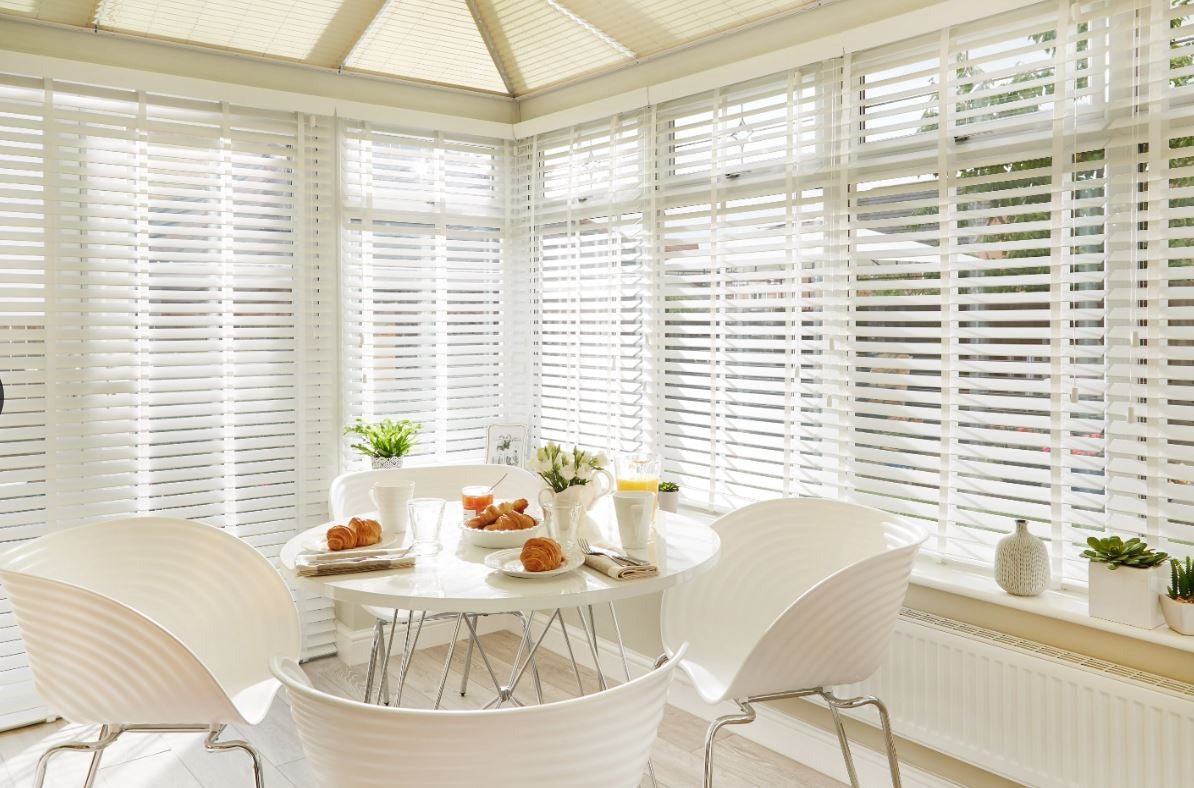
Conservatories are the clearest case for thermal blinds. A glazed structure with a glass roof and three glazed walls loses heat at an extraordinary rate in cold weather. Thermal blinds for conservatories — particularly double-cell honeycomb blinds on the walls and purpose-made cellular blinds for the roof panels — can transform the usability of a conservatory in winter. The improvement in comfort is not marginal; it is often the difference between a room that is too cold to use from October to March and one that remains comfortable for much of the year.
North-Facing Rooms
Rooms with no direct solar gain — north-facing living rooms, rear bedrooms that receive morning sun only — have no passive solar heating during the day to offset window heat loss. In these rooms, the proportion of heating demand accounted for by window heat loss is higher than average, and thermal blinds deliver a proportionally greater benefit.
Rooms With Older Glazing
The thermal performance of a double-glazed unit degrades as the seal around the edge fails and the insulating gas (typically argon) escapes. An older double-glazed unit with a failed seal performs closer to single glazing than to modern high-specification glazing. Thermal blinds are particularly effective on these windows — the additional insulating layer compensates significantly for the degraded glazing performance without requiring the expense and disruption of window replacement.
Thermal Blinds in Summer: The Overlooked Benefit
The same properties that make thermal blinds effective in winter also make them useful in summer. A blind that slows heat loss outward in cold weather also slows solar heat gain inward when the sun is strong. A thermal or honeycomb blind on a south or west-facing window will reduce the rate at which the room heats up during the warmest part of the day, reducing reliance on electric fans or air conditioning.
For the UK, where summer temperatures above 28°C are increasingly common and most homes have no air conditioning, this cooling effect is a practical benefit that has grown in relevance. A thermal blind that reduces summer overheating as well as winter heat loss is earning its cost in both seasons.
Getting the Most From a Thermal Blind
Thermal performance is maximised when the blind is fitted with minimal gaps between the blind and the window frame. A honeycomb blind in a snug recess fit — or a perfect fit honeycomb blind clipped directly into the window bead — prevents warm room air from circulating behind the blind and reaching the cold glass, which is the main route by which the insulating effect is undermined.
Closing the blind overnight and during the coldest parts of the day delivers the most benefit. A thermal blind that is raised during the day to admit winter sunlight and closed at dusk to retain the heat captured during daylight hours is being used in the way that produces the best combined result: passive solar gain during the day, reduced conductive and convective heat loss in the evening and overnight.
The Summary
Thermal blinds reduce window heat loss, improve room comfort and provide a modest but measurable energy saving. The most effective type is a double-cell honeycomb blind in a well-fitted installation. The greatest benefits accrue in conservatories, rooms with older glazing, and north-facing rooms with high window-to-floor ratios. The comfort improvement — warmer rooms at the window, no cold downdraft on winter evenings — is felt immediately and independently of the bill saving.
Browse the full range of thermal blinds and honeycomb blinds to find the right specification for your windows and rooms.