Skip to content


 Vertical Blinds
 Roman Blinds
 Roller Blinds
 Venetian Blinds
 Day and Night Blinds
 Skylight Blinds
 Children
 Wooden Blinds
 Curtains
 Blinds Accessories
 White
White Yellow
 Gold
Gold Green
Green Grey
Grey Pink
Pink Orange
 Animal
 Floral
 Geometric
 Striped
 Motorized Day and Night Blinds
 Motorized Roller Blinds
 No Drill Rollers
 Perfect Fit Wooden
 Perfect Fit Metal
 Thermal Blinds
 Better Sleep Blinds
 Cordless Blinds
 No Drill Blinds
 Blackout Blinds
 Waterproof Blinds
 Easy Wipe Blinds
 Taped Blinds
 Conservatory
 Office
 Kitchen
 Bathroom
 Dining Room
 Kids Room
 Living Room
 Bedroom
 Bay Window
 Conservatory Window
 Tild and Turn Window
 Bi Fold Window
 Roof of Skylight
 French Door
 Sliding Door
Day and Night Blinds for Bedrooms: Privacy, Light and Style Guide
- by Mariam Labadze
 Bedrooms demand more from a window blind than any other room. You need darkness for sleeping, filtered light for lazy weekend mornings, privacy at all hours, and something that looks good enough to set the tone for your personal space. Day and night blinds — also called vision blinds, zebra blinds or duo blinds — deliver all of this from a single product. Their alternating sheer and opaque fabric bands let you shift from full privacy to soft daylight with a simple adjustment. In this guide, we look at why day and night blinds are particularly well suited to bedrooms and how to choose the right colour, style and features for restful sleep.
Quick Answer: Day and night blinds are an excellent choice for bedrooms because they combine light filtering and privacy control in one blind. By aligning the opaque bands, you can achieve near-blackout darkness for sleep. They are available in calming bedroom-friendly colours, motorised versions for convenience, and cordless designs that meet UK child safety standards.
How Day and Night Blinds Work
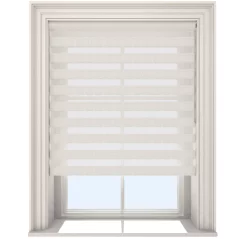
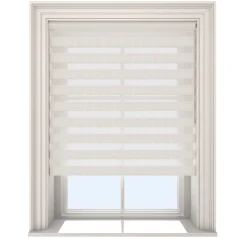
Aday and night blinduses a continuous loop of fabric with alternating horizontal bands — one sheer (translucent) and one solid (opaque). Because the fabric loops around a roller, you can shift the position of the bands relative to each other. When the sheer bands align, light passes through and you get a soft, diffused glow. When the opaque bands overlap, light is blocked and privacy is maximised.
This dual functionality means you do not need two separate blinds — a voile for daytime and a blackout for night. One product handles both roles, which is especially valuable in a bedroom where your lighting needs change dramatically between morning and evening.
Can Day and Night Blinds Achieve Blackout?
This is the most common question homeowners ask, and the honest answer is: very nearly. When the opaque bands are fully overlapped, most day and night blinds block around 85–95% of incoming light. This is comparable to a dimout blind and is dark enough for most people to sleep comfortably.
However, because there are still slight transitions between the bands and small gaps at the fabric edges, they do not achieve the 99–100% light blockage of a dedicatedblackout blind. If you are extremely sensitive to light — or fitting a nursery for a newborn — a true blackout roller or honeycomb blind may be the better choice. For the majority of adult bedrooms, though, day and night blinds provide more than enough darkness for restful sleep.
Improving Blackout Performance
-
Choose a darker fabric colour. Deep charcoal, navy or black opaque bands block more light than pale tones.
-
Fit inside the recess. This reduces the gap between the fabric edge and the window reveal.
-
Add a cassette headbox. A cassette encloses the roller and prevents light from leaking over the top.
Choosing the Right Colour for a Bedroom
Colour has a measurable effect on how a room feels and, arguably, how well you sleep. Here are some guidance points specifically for bedroom day and night blinds.
Calming Neutrals
Soft greys, warm taupes and muted creams are the most popular bedroom choices. They complement virtually any décor, reflect gentle light when the sheer bands are open, and do not dominate the room when the blind is fully closed. Grey tones, in particular, offer a good balance between style and light-blocking performance.
Cool Blues and Greens
Research consistently links blue and green tones with feelings of calm and lower heart rates. A dusky blue or sage green day and night blind can contribute to a more relaxing bedroom atmosphere — a subtle touch that many homeowners appreciate once they experience it.
Bold and Dark Tones
Charcoal, anthracite and deep navy are growing in popularity, especially in modern or Scandi-style bedrooms. They provide the best light-blocking performance of any colour and create a cocooning effect that many people find conducive to sleep. The sheer bands in darker fabrics still allow light in during the day, so the room does not feel gloomy when open.
Motorised Day and Night Blinds for Bedrooms
If there is one room where motorised blinds make the most practical difference, it is the bedroom. Withmotorised day and night blinds, you can open or close the blind from bed using a remote control or smartphone app. No more stumbling across a dark room to pull a chain. Some motorised systems also support timers, so the blind can gradually open in the morning to simulate a natural sunrise — a far gentler wake-up than an alarm.
Smart Home Integration
Many motorised blind motors are compatible with Alexa, Google Home or Apple HomeKit. Voice commands like "close the bedroom blinds" become part of a bedtime routine, alongside dimming the lights and setting the thermostat. It sounds like a luxury, but once you have it, it becomes something you rely on daily.
Child Safety Considerations
UK regulations and the British Blind and Shutter Association (BBSA) guidelines are clear: looped cords and chains on blinds pose a strangulation risk to young children. In a bedroom — particularly a child's bedroom or a room where children visit — safety is non-negotiable.
Day and night blinds are available incordless designsthat use a spring mechanism or wand control instead of a chain. Motorised options also eliminate cords entirely. If your day and night blind does use a chain, fit a chain safety device (a breakaway connector and a wall-mounted tensioner) to reduce the risk. 1ClickBlinds includes child safety information with all products and offers cordless alternatives where possible.
Styling Day and Night Blinds in a Bedroom
Beyond colour, there are several ways to make day and night blinds work as a design feature rather than a purely functional fitting.
Layering with Curtains
Day and night blinds sit close to the window, making them easy to layer behind curtains. Use the blind for daily light control and add dress curtains in a complementary fabric to soften the window and add warmth. This layered look is particularly effective in larger bedrooms or rooms with tall windows.
Matching Multiple Windows
If your bedroom has two or more windows, always order the same fabric for all of them. Even slight colour variations between batches can be noticeable, especially in a room where you spend a lot of time. Order all blinds together to ensure consistency.
Minimalist Approach
In a contemporary bedroom, a day and night blind on its own — without curtains or pelmets — can be all you need. The horizontal banding creates a subtle pattern that adds visual interest without clutter. A white or light grey fabric against a white wall gives a clean, airy Scandinavian feel.
Measuring and Fitting Tips for Bedrooms
Fitting day and night blinds follows the same principles as any roller-style blind. Measure the width and drop in three places and use the smallest figures for recess fitting or the largest for face fitting. Ensure the recess depth is at least 65 mm for a standard headrail, or consider face fixing if the recess is shallow.
In bedrooms, face fixing with a 50–75 mm overlap on each side can be a smart move because it reduces light leakage around the edges — useful when you want the darkest possible sleeping environment.
Frequently Asked Questions
Are day and night blinds good for bedrooms?Yes, day and night blinds are well suited to bedrooms because they offer adjustable light control — from soft filtered daylight to near-blackout darkness — all in a single blind. They also provide excellent privacy at any setting.
Do day and night blinds block enough light for sleeping?When the opaque bands are fully overlapped, day and night blinds block approximately 85–95% of light, which is sufficient for most people. For complete blackout, choose a dark fabric colour and fit the blind inside the recess with a cassette headbox to minimise light gaps.
Are day and night blinds safe for children's bedrooms?Day and night blinds are safe for children's bedrooms if you choose a cordless or motorised version that eliminates loose chains and cords. If a chain-operated model is used, a breakaway connector and wall tensioner must be fitted in line with UK child safety standards.
Can I get motorised day and night blinds?Yes, motorised day and night blinds are available and are particularly useful in bedrooms. They can be controlled via remote, smartphone app or smart home systems, and some support timed schedules for gradual morning opening.