Skip to content


 Vertical Blinds
 Roman Blinds
 Roller Blinds
 Venetian Blinds
 Day and Night Blinds
 Skylight Blinds
 Children
 Wooden Blinds
 Curtains
 Blinds Accessories
 White
White Yellow
 Gold
Gold Green
Green Grey
Grey Pink
Pink Orange
 Animal
 Floral
 Geometric
 Striped
 Motorized Day and Night Blinds
 Motorized Roller Blinds
 No Drill Rollers
 Perfect Fit Wooden
 Perfect Fit Metal
 Thermal Blinds
 Better Sleep Blinds
 Cordless Blinds
 No Drill Blinds
 Blackout Blinds
 Waterproof Blinds
 Easy Wipe Blinds
 Taped Blinds
 Conservatory
 Office
 Kitchen
 Bathroom
 Dining Room
 Kids Room
 Living Room
 Bedroom
 Bay Window
 Conservatory Window
 Tild and Turn Window
 Bi Fold Window
 Roof of Skylight
 French Door
 Sliding Door
Perfect Fit Pleated Blinds: The Best No-Drill Option?
- by Mariam Labadze
 The question in the title is a genuine one rather than a rhetorical device. Perfect fit blinds as a category have a clear best-in-class product for most applications — the honeycomb blackout blind for bedrooms and rooms where thermal performance and complete light exclusion are the priorities. But the honeycomb format doesn't suit every room or every brief, and the pleated blind — the format that shares the perfect fit clip system while offering a different fabric character and a wider aesthetic range — fills a specific set of requirements that the honeycomb doesn't address as well.
Whether the pleated format is the best no-drill option depends on what you need the blind to do. This guide answers that question directly — how pleated blinds work, what they offer that other perfect fit formats don't, where they perform best, and where the honeycomb or roller alternatives are the more appropriate choice.
[toc]
What a Perfect Fit Pleated Blind Is
A perfect fit pleated blind combines two distinct product technologies: the perfect fit clip-frame mounting system and the pleated blind operating format.
The perfect fit system clips directly into the UPVC glazing bead — the rebated channel around the inner edge of the window frame that holds the glass. No drilling, no wall fixings, no screws into the frame. The outer clip frame engages with the glazing bead mechanically, and the blind mechanism sits within this outer frame. The blind covers the glass edge to edge with no gap at any side, because it occupies the same space as the glass within the frame geometry.
The pleated blind mechanism within the frame consists of a fabric that folds into a series of compressed pleats at the top when the blind is raised and fans out as concertina folds across the glass when lowered. Unlike a roller blind — which winds onto a tube and creates a progressively larger roll — a pleated blind always folds flat, which means it stacks compactly at the top of the frame regardless of the drop. Unlike a honeycomb blind — which uses the same folding principle but with a cellular cross-section — a pleated blind uses a single layer of fabric without the structural air cell.
The operating mechanism is typically a pair of cords running through the pleated fabric from top to bottom, tensioned between the fixed top headrail and the moveable bottom rail. Raising or lowering the blind adjusts the bottom rail position and determines how much of the glass the fabric covers.
The Fabric: Where Pleated Blinds Differ From Every Other Format
The fabric is the most significant differentiator between pleated blinds and other perfect fit formats, and it's the reason the format exists as a distinct product category rather than being subsumed by the honeycomb blind.
Pleated blind fabric is available in a wider range of materials, textures, patterns, and opacity levels than any other blind format. The reason is structural — where a roller blind fabric must roll cleanly onto a tube without creasing, and a honeycomb fabric must fold into precise cellular cross-sections, pleated fabric simply needs to fold into consistent pleats. This is a much less demanding structural requirement that opens the format to a much wider range of materials.
Sheer and Voile Fabrics
The most distinctive capability of the pleated format is the availability of genuinely sheer fabrics — open-weave voiles and translucent materials that admit diffused light while providing privacy. These fabrics are not available in roller or honeycomb format because they lack the structural properties needed for rolling or cellular construction.
A sheer pleated fabric in a perfect fit frame creates a window treatment that filters light softly — similar to a net curtain in its functional effect but with the clean geometry of a blind and without the domestic associations that net curtains carry. For rooms where privacy is needed without significant light reduction — a ground-floor living room that requires privacy from the street while remaining bright, a conservatory where some filtered light is preferable to full transparency — the sheer pleated blind is the specific product that addresses this requirement.
No other perfect fit format offers genuine sheer light transmission. The honeycomb blind's minimum opacity is room-darkening rather than genuinely translucent, and the roller blind's fabric range, while wide, doesn't extend to open-weave voiles without losing the structural properties the roll requires.
Patterned and Textured Fabrics
Pleated fabrics are available in patterns — geometric prints, subtle textures, botanical motifs — in a way that roller and honeycomb formats aren't. The flat, folded surface of a lowered pleated blind presents the fabric pattern clearly without the distortion that a rolled fabric creates around a tube or the cell-wall texture that characterises honeycomb fabric.
For rooms where the blind is a design element rather than a background — a bathroom with a botanical print fabric, a child's bedroom with a geometric pattern, a conservatory with a fabric that references the room's colour scheme — the patterned pleated blind provides a design specificity that plain white or neutral roller and honeycomb blinds don't offer.
Opacity Range
The pleated format covers the full opacity spectrum: genuinely sheer at one end, through light-filtering, room-darkening, and at the other end, blackout-rated fabrics that achieve 0% light transmission. This range within a single format and mounting system means that the same clip frame fitted to windows throughout a property can carry different fabric specifications in different rooms — sheer in the living room, room-darkening in a home office, blackout in the bedroom — with a consistent clean appearance and mounting approach across all of them.
Thermal Fabrics
Some pleated blind fabrics incorporate a thermal or reflective backing — typically a metallic or foam layer bonded to the back of the face fabric — that improves the blind's thermal performance without the structural complexity of a honeycomb cell. These perform less well thermally than a honeycomb blind — the unsealed single fabric layer doesn't trap air as effectively as the sealed cellular structure — but they improve on a standard unlined fabric, and they carry the aesthetic qualities of the face fabric rather than the distinctive cell-wall texture of honeycomb construction.
For rooms where some thermal improvement is wanted alongside an attractive fabric appearance — a conservatory, a living room with large south-facing glazing — a thermally-backed pleated blind in a perfect fit frame is a reasonable middle ground between a standard roller blind and a full honeycomb product.
Perfect Fit Pleated vs Perfect Fit Honeycomb: The Direct Comparison
This is the comparison that most buyers considering perfect fit blinds need to make, because the two formats share the same mounting system and are used in overlapping applications.
Where Honeycomb Wins
Thermal performance is the clearest advantage. The cellular structure of a honeycomb blind traps a column of still air between the glass and the room, creating an insulating layer that a single pleated fabric layer cannot replicate regardless of its backing. In a bedroom in winter, or a conservatory facing north, or any room where the glass surface is a significant source of cold radiation or heat loss, the honeycomb blind is the better thermal product by a meaningful margin.
Blackout performance at the fabric level is also stronger in honeycomb format. The cell wall density that provides structural integrity also provides opacity without requiring a separate applied coating — and because the opacity is structural rather than surface-applied, it doesn't degrade over time. A honeycomb blackout blind maintains its fabric-level performance indefinitely. A pleated blackout blind uses a coated fabric that, while effective when new, is subject to the same coating degradation over years of folding and unfolding that coated roller fabrics are subject to on a roll.
For bedrooms, nurseries, and east-facing rooms where the blackout brief is primary, the honeycomb blackout blind remains the strongest recommendation.
Where Pleated Wins
Fabric range is where the pleated blind's advantage is substantial and unambiguous. Sheer fabrics — genuinely translucent, open-weave voiles — are not available in honeycomb format. Patterned fabrics are not available in honeycomb format. Textured fabrics that prioritise surface appearance over thermal performance are far more widely available in pleated format.
For rooms where the aesthetic quality of the fabric is the primary consideration — a living room, a conservatory, a kitchen with a specific colour scheme — the pleated blind offers a range of options that the honeycomb format simply can't match.
Stack height is a practical consideration for taller windows. Both pleated and honeycomb blinds stack at the top when raised, but the stack height differs. A honeycomb blind stacks into a relatively compact column because the cell structure, though rigid, compresses into a consistent depth. A pleated blind stacks into an equivalent or slightly more compact profile because the single-layer fabric folds flatter than the cellular structure. For very tall windows — floor-to-ceiling glazing, tall conservatory panels — the difference in stack height at the top of the window is worth calculating for the specific blind height before ordering.
Aesthetic Difference
The visual character of the two formats differs in the lowered position. A honeycomb blind has a distinctive cell-wall texture that is visible from close range and gives the blind a structured, almost architectural quality — it reads as a product designed around a structural principle rather than a fabric panel. A pleated blind reads more like fabric — the individual pleats create a soft, fine-ridged surface that has a domestic warmth that the honeycomb structure doesn't quite replicate.
For rooms where the blind should feel soft and textile-like — living rooms, bedrooms used as retreats, bedrooms with a decorative brief — the pleated fabric surface is often the more appropriate aesthetic. For rooms where the brief is functional performance — bedrooms used primarily for sleep, nurseries, east-facing rooms — the honeycomb's structural character is a secondary consideration to its blackout and thermal performance.
Perfect Fit Pleated vs Perfect Fit Roller: The Other Comparison
Profile and Stack
A roller blind in a perfect fit frame raises into a progressively larger roll at the top of the frame. At the raised position, the roll occupies a visible portion of the top of the frame — typically 30 to 50mm for a standard fabric roller — and is visible as a cylindrical form within the frame geometry. A pleated blind stacks into a flat-folded compressed panel at the top that takes up a similar or smaller height but presents as a flat, orderly stack rather than a cylindrical roll.
For windows where the blind is frequently raised and the raised appearance matters — a living room where the blind is up during the day — the flat stack of a pleated blind is often neater in appearance than the cylindrical roll profile of a raised roller.
Mid-Position Operation
A pleated blind can be positioned at any point between fully raised and fully lowered, covering any portion of the window from none to all. Because the fabric folds flat against itself rather than winding onto a tube, the mid-position is as stable as either extreme — the blind sits reliably at the chosen height without any spring-back or tension return.
This mid-position capability suits rooms with overlooked windows where partial coverage — covering the lower half of the window to screen street-level sightlines while leaving the upper half open — is the preferred daily position. The pleated blind holds this position with the same stability as the fully lowered position, without the tension-spring behaviour of some roller mechanisms.
Fabric Comparison
Roller blinds have a wider range of fabric options than pleated blinds in one specific direction — heavier, denser fabrics that require the structural tension of a roller mechanism to hang straight are available in roller format only. For very heavy blackout fabrics or for fabrics with significant structural weight, the roller is the appropriate format.
Pleated blinds have a wider range in the other direction — sheer, open-weave, and patterned fabrics that can't be rolled without distortion or damage are available in pleated format only.
For most standard domestic applications — room-darkening or blackout fabrics for bedrooms, light-filtering neutrals for living rooms — the fabric quality difference between the two formats is minimal and the choice is more about the operating mechanism and aesthetic character than any significant fabric performance difference.
Where Perfect Fit Pleated Blinds Work Best
Conservatories
The conservatory is the application where the pleated blind most comprehensively outperforms alternatives. Conservatory glazing — roof panels, side panels, sloped glazing, full-length vertical panels — presents a range of shapes and orientations that most blind formats handle poorly.
Standard UPVC conservatory glazing bead is compatible with the perfect fit clip system, which means pleated blinds can be fitted to conservatory roof panels as well as vertical side windows without any drilling or additional fixings. The compact stack height of a pleated blind on a roof panel — where the raised blind needs to clear the glazing without obstructing the internal space — is a practical advantage over roller formats.
Conservatory roof panels receive direct overhead sun in summer — the primary cause of conservatory overheating — and are the most significant source of heat loss in winter. A thermally-backed pleated fabric in a perfect fit frame on each roof panel provides meaningful solar management in summer and some thermal improvement in winter, without the complete interior transformation that full conservatory roof replacement or solid roof covering would require.
Sheer pleated fabrics suit conservatory side windows where the purpose of the conservatory depends on its connection to the garden — a sheer blind on the side panels maintains the light and view while providing some privacy and reducing direct glare.
Living Rooms
Ground-floor living rooms in terraced and semi-detached properties — where privacy from the pavement or neighbouring garden is needed without sacrificing natural light — are the strongest domestic application for sheer pleated blinds.
A sheer pleated blind in a perfect fit frame on a UPVC living room casement window provides the same privacy function as a net curtain — preventing a direct view into the room from outside while admitting diffused daylight — without the domestic character of gathered net curtain fabric or the need for a separate curtain track. The blind sits within the frame, leaving the window surround and any curtains outside the frame completely independent.
For living rooms used across a range of light conditions — morning reading, afternoon sun management, evening privacy with interior lighting — combining a sheer pleated blind in the frame with a heavier curtain panel outside gives a layered treatment that addresses all conditions simultaneously. The sheer blind manages daylight and privacy during the day; the curtain is drawn in the evening for warmth and privacy when interior lighting makes the window transparent from outside.
Bathrooms
The pleated format suits bathrooms where a softer fabric treatment is preferred to the harder Venetian slat alternatives. A pleated blind in a moisture-appropriate fabric — the specification should include a moisture-resistant fabric treatment rather than standard pleated fabric — brings a textile quality to the bathroom window that aluminium or PVC slats don't provide.
The perfect fit no-drill mounting is particularly appropriate for bathrooms because it eliminates the need to drill into tiled or plastered bathroom walls — one of the most problematic fixing situations in domestic installation, where moisture ingress at drill holes is a persistent risk. The clip frame engages with the UPVC window glazing bead without touching the surrounding wall surface.
For bathroom windows where a pattern or colour-matched fabric would suit the room's design scheme, the pleated format's wider fabric range is a practical advantage over the more limited neutral palette of honeycomb and standard roller alternatives.
Roof Windows and Skylights
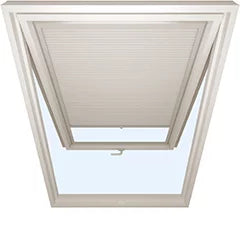
The pleated blind is the standard solution for VELUX and equivalent roof window applications. The specific geometry of a roof window — a casement or pivot-opening frame set into a sloped roof — requires a blind that sits within the frame and moves with the window when it opens, and that holds its position under gravity when the window is installed in a sloped orientation.
Perfect fit pleated blinds on roof windows use a clip frame that engages with the roof window's internal frame, with the blind supported by the cord tensioning system rather than relying on gravity. The blind can be positioned at any point along the window and held there by the cord tension — unlike a roller blind on a sloped surface, which requires specific spring tension calibration to hold position against gravity.
This is one of the clearest specific applications where the pleated format in a perfect fit mounting is the correct product rather than a preference — the roof window environment is one that the format handles naturally and that alternatives manage only with mechanical complexity.
Home Offices and Studies
The sheer and light-filtering pleated fabric options suit home offices where screen glare management is a daily requirement but complete darkness is not. A light-filtering pleated blind — not blackout, not sheer, but an intermediate translucent fabric that diffuses direct light without eliminating it — in a lowered position reduces the contrast between a bright window and a darker screen surround, which is the specific cause of screen glare fatigue.
The mid-position operation of a pleated blind is useful in a home office where the sun angle changes through the working day — the blind can be set at various heights to track the sun's movement, covering the portion of the window where direct light falls on the screen without blocking the portions of the window that provide ambient light rather than direct glare.
Measuring and Fitting Perfect Fit Pleated Blinds
Checking UPVC Glazing Bead Compatibility
The perfect fit clip system requires a UPVC glazing bead — the rebated channel that holds the glass within the UPVC frame. Most standard UPVC casement, tilt-and-turn, and conservatory windows in UK properties built since the mid-1980s have compatible glazing bead profiles. Bay window UPVC, bifold door frames, and some older UPVC profiles may have non-standard bead dimensions that the standard clip system doesn't engage correctly.
Before ordering, confirm bead compatibility by measuring the bead width and depth and comparing against the clip system specification provided by the supplier. Most suppliers offer a free sample clip or a compatibility checking guide for this purpose. For roof windows, confirm the specific VELUX or roof window model and year — clip system compatibility varies by roof window manufacturer and frame generation.
Measurement
Unlike conventional blinds where the buyer measures the window and the blind is made to those dimensions, perfect fit blinds are measured differently. The outer frame dimensions are determined by the glass dimensions — the size of the glass pane within the UPVC frame — rather than the overall window frame size.
Measure the glass width and height inside the glazing bead on all four sides. The glass measurement — not the frame measurement — is what most perfect fit suppliers require. Some suppliers request measurements from the inner edge of the glazing bead rather than the glass edge itself — confirm which measurement convention the supplier uses before measuring, as using the wrong convention produces a clip frame that either doesn't reach the bead or overlaps it by too much.
For windows with any inconsistency between opposite sides — slightly different measurements between left and right glass edge, or top and bottom — use the smallest measurement and confirm with the supplier how dimensional inconsistency is handled in their manufacturing process.
Installation
Installation follows the standard perfect fit process applicable to all formats in the clip system. Identify the four corner positions where the outer clip frame corners engage with the glazing bead. Press the corner clips into the bead channel — they should engage with a positive click. With corner clips seated, press the remaining clips along each side into the bead channel in sequence. Once all clips are engaged, press the blind mechanism into the outer frame until it seats correctly.
The installation requires no tools, no screws, and no drilling. Total installation time for a standard casement window is typically five to ten minutes, including checking the clip engagement and confirming the blind operates correctly before finishing.
For roof windows in a sloped ceiling position, the installation approach is the same but should be performed from a stable step platform — the overhead position makes working at the frame angle more demanding than a vertical window installation.
Common Questions About Perfect Fit Pleated Blinds
How do I clean a pleated blind?
Surface dust can be removed with a soft brush or low-suction vacuum brush attachment, working along the horizontal pleats. The pleated structure traps dust in the folds more readily than a flat roller fabric — regular light dusting prevents heavy accumulation.
For more thorough cleaning, the blind can be removed from the clip frame by releasing the mechanism from the outer frame, lowered to its fully extended position, and wiped along the pleat faces with a damp cloth. The blind should be allowed to dry fully before being raised and the pleats compressed — damp fabric folded tightly can develop mildew in the compressed pleat stack.
Can I fit a pleated blind to a window that also has a handle?
The perfect fit clip system clips to the glazing bead within the frame, so the blind operates within the frame area rather than in front of the glass. Standard UPVC casement handles are mounted to the frame rather than the glass area and do not conflict with a correctly fitted perfect fit blind in most window configurations. For windows where the handle is positioned unusually — a top-mounted handle in some tilt-and-turn configurations — confirm the handle position against the clip frame dimensions before ordering.
Do pleated blinds work on tilt-and-turn windows?
Yes — and this is one of the strongest applications for the format. A perfect fit blind on a tilt-and-turn window clips to the opening sash and tilts with the window, maintaining coverage with the window in the ventilation position. The pleated format handles the tilt-open position well — the fabric folds compress and extend without any conflict with the opening movement because the blind sits within the sash frame rather than in front of it.
Is the pleated format available in double-window configurations?
For larger openings or wider windows consisting of two panes side by side — common in bay window configurations — separate perfect fit frames and blinds are fitted to each pane independently. The junction between adjacent panes creates a slight frame overlap where the two clip frames meet, which is typically 20 to 30mm wide. This is the same approach used for other perfect fit formats on multi-pane windows and is the standard method rather than a limitation specific to the pleated format.
Price Guide for 2026
Perfect fit pleated blinds sit at a mid-point in the perfect fit pricing range — above perfect fit roller blinds, broadly comparable to or slightly below perfect fit honeycomb blinds depending on fabric specification.
Standard light-filtering pleated fabrics in perfect fit format for a standard UK casement window typically range from £50 to £90 depending on width and fabric specification. Sheer and voile fabrics sit toward the lower end of this range — the fabric itself is less material-intensive than room-darkening alternatives. Thermally-backed fabrics and premium patterned fabrics sit at the upper end.
Blackout-rated pleated fabrics in perfect fit format typically range from £65 to £110, reflecting the additional fabric construction required for 0% transmission performance. This is broadly comparable to perfect fit honeycomb blackout blinds — the decision between the two formats for blackout applications is therefore more about fabric character and thermal performance than cost.
Conservatory roof panel blinds in perfect fit pleated format carry a premium reflecting the larger glass dimensions of typical conservatory panels — roof panel glass is often larger than standard casement window glass, and the clip frame and fabric dimensions increase proportionally with the glass size.
The Honest Answer to the Title Question
Is the perfect fit pleated blind the best no-drill option?
For specific applications — yes, clearly. For conservatory roof windows where the format is the natural solution. For living rooms and ground-floor rooms where a sheer fabric treatment that perfect fit honeycomb or roller formats can't offer is the right brief. For bathrooms where a fabric aesthetic is preferred to Venetian slats. For tilt-and-turn windows across any room type where the ventilation-with-coverage capability is wanted in a lighter fabric character than the honeycomb provides.
For bedrooms where complete blackout and thermal performance are the priorities — no. The honeycomb blackout blind is the stronger product in that application, and the pleated format's fabric advantages don't outweigh the honeycomb's structural superiority for sleep-critical environments.
The pleated blind is the best no-drill option for rooms where fabric range, aesthetic variety, and the sheer light-filtering capability matter most. It is not a universal best — but for the specific rooms and briefs it suits, it is the only perfect fit format that addresses those requirements at all. That specificity is its genuine strength rather than a limitation.