Skip to content


 Vertical Blinds
 Roman Blinds
 Roller Blinds
 Venetian Blinds
 Day and Night Blinds
 Skylight Blinds
 Children
 Wooden Blinds
 Curtains
 Blinds Accessories
 White
White Yellow
 Gold
Gold Green
Green Grey
Grey Pink
Pink Orange
 Animal
 Floral
 Geometric
 Striped
 Motorized Day and Night Blinds
 Motorized Roller Blinds
 No Drill Rollers
 Perfect Fit Wooden
 Perfect Fit Metal
 Thermal Blinds
 Better Sleep Blinds
 Cordless Blinds
 No Drill Blinds
 Blackout Blinds
 Waterproof Blinds
 Easy Wipe Blinds
 Taped Blinds
 Conservatory
 Office
 Kitchen
 Bathroom
 Dining Room
 Kids Room
 Living Room
 Bedroom
 Bay Window
 Conservatory Window
 Tild and Turn Window
 Bi Fold Window
 Roof of Skylight
 French Door
 Sliding Door
Real Wood vs Faux Wood Blinds: Honest Comparison for UK Homes
- by Mariam Labadze
 The faux wood blind exists because of one problem with real wood blinds that no amount of finish, treatment, or product development has fully solved: wood and moisture don't coexist comfortably over time. Faux wood was the industry's answer to that limitation, and it has evolved from an obviously inferior substitute into a product that, in certain applications and at certain quality levels, is genuinely difficult to distinguish from the real thing and outperforms it on the metrics that matter most in those specific rooms.
The honest comparison between the two isn't a question of which is better overall. It's a question of which is better for your specific window, your room, your budget, and your tolerance for maintenance. Those variables produce different answers in different situations, and this guide works through each of them directly.
[toc]
What They're Made From
Understanding the material difference before evaluating performance prevents the comparison from being purely abstract.
Real Wood Blinds
Real wood Venetian blinds use actual timber slats — typically basswood, paulownia, or bamboo depending on the manufacturer and price point. Basswood is the traditional premium choice: lightweight relative to its strength, with a fine, consistent grain that takes stain and paint evenly and produces a clean finish at narrow slat widths. Paulownia is lighter still, with a slightly coarser grain, and is used more commonly in budget real wood blinds where slat weight and cost are the primary considerations. Bamboo is technically a grass rather than a timber but is processed and used in a similar format — it has a distinctive grain character that reads differently from traditional wood and suits specific interior styles rather than general domestic use.
The timber is kiln-dried before processing to reduce moisture content and dimensional instability, cut into slats, shaped, and finished with stain, paint, or lacquer. The finish provides some protection against moisture absorption and surface damage, but it is a surface treatment rather than a structural modification — the timber beneath remains susceptible to humidity, swelling, and warping if the moisture challenge exceeds what the finish can manage.
Faux Wood Blinds
Faux wood blinds are manufactured from one of two base materials: PVC or a wood-polymer composite.
PVC faux wood uses a rigid PVC extrusion with a surface embossed or printed to replicate wood grain. It is entirely synthetic, completely moisture-resistant, and dimensionally stable under virtually all domestic conditions. The grain replication in quality products is convincing at normal viewing distances — close inspection reveals the uniformity of a printed surface rather than the natural variation of real timber, but in a fitted blind at window height, the difference is not readily apparent.
Wood-polymer composite faux wood uses a blend of real wood fibre and polymer resin — typically 30 to 50 percent wood content — compressed and shaped into slats. The composite material has a more authentic feel and appearance than pure PVC, with some of the natural variation of real timber in the surface finish, while the polymer content provides substantially better moisture resistance than solid wood. It sits between pure PVC and real timber in terms of both appearance authenticity and moisture sensitivity.
Appearance: How Close Is Faux Wood Really?
This is the question that most buying guides avoid answering directly because the honest answer is conditional.
At a Distance
In a fitted blind on a window, viewed from across the room or from outside the property, good quality faux wood is visually indistinguishable from real wood in most painted finishes. The slat profile, the finish quality, and the operating hardware are identical. White painted faux wood against a white painted window frame reads exactly as white painted real wood does — the grain is covered by the paint in both cases and the material beneath is not visible.
In stained or natural finishes, the difference is slightly more apparent. Real wood grain has natural variation — colour shifts, growth ring patterns, the minor inconsistencies of biological material. High-quality faux wood in a stained finish replicates the general character of wood grain but with less variation than the real thing. Quality faux wood from a specialist blind supplier is close enough that most people don't notice the difference in situ. Entry-level faux wood from a budget retailer is noticeably repetitive — the same printed pattern tiling across the slats in a way that reads as synthetic rather than natural at close range.
Up Close
The material difference is more apparent at close inspection. Real wood has warmth, depth, and variation that no current synthetic material fully replicates. The tactile quality is different — wood has texture that varies across the grain, faux wood has a consistent surface that, regardless of how convincingly it's printed, feels like what it is.
For a living room in a period property where the blinds are an aesthetic feature and the window is at eye level, this distinction matters. For a bathroom or kitchen window where the blind is a functional element rather than a design statement and is viewed more often from across the room than up close, it doesn't.
Painted Finishes
Both materials take painted finishes that are visually equivalent at normal viewing distances. White, off-white, and neutral grey painted finishes — the most common blind colours in contemporary UK interiors — look the same in both materials. If your planned finish is painted rather than stained, the visual case for real wood over faux wood is significantly weaker.
Moisture and Humidity: The Core Practical Difference
This is where the comparison is most clear-cut and where the recommendation differs most decisively by room.
How Moisture Affects Real Wood
Wood is hygroscopic — it absorbs and releases moisture in response to the humidity of the surrounding air. When humidity rises, wood absorbs moisture and expands slightly. When humidity falls, it releases moisture and contracts. Repeated cycles of expansion and contraction cause the timber to warp, cup, bow, and eventually crack along the grain.
In a bedroom or living room in a well-ventilated UK home, the humidity variation is modest enough that a well-finished real wood blind remains stable for years. The slats expand and contract slightly through the seasons but the cumulative deformation is manageable and the finish remains intact.
In a bathroom or kitchen, the humidity challenge is a different order of magnitude. A bathroom generates significant steam during showers, which raises local humidity rapidly and repeatedly. A kitchen above a hob produces steam, grease, and humidity in combination. The finish on real wood slats in these conditions is continuously challenged — moisture penetrates at edges, end grain, and any point where the surface coating has been abraded. Once moisture penetration begins, the slats warp progressively and the damage is irreversible.
How Moisture Affects Faux Wood
PVC faux wood has zero moisture sensitivity. Humidity, steam, condensation, and direct water contact cause no dimensional change, no warping, no cracking, and no surface deterioration in quality PVC products. A PVC faux wood blind in a bathroom shower room will look identical in year five to year one.
Wood-polymer composite faux wood has significantly better moisture resistance than real timber but is not completely immune to moisture effects. High humidity over extended periods can cause slight dimensional changes in composite slats, though the polymer content substantially dampens the expansion-contraction response compared to solid timber. For most bathroom and kitchen applications, composite faux wood is entirely adequate. For steam rooms or exceptionally humid environments, pure PVC is the more conservative choice.
The Practical Verdict by Room
Kitchens and bathrooms: faux wood is the correct material choice. Real wood blinds in these rooms are a maintenance problem waiting to happen — not necessarily immediately, but progressively over two to three years of regular moisture exposure. The question is not whether real wood will warp in a bathroom but when.
Living rooms, bedrooms, dining rooms, home offices: both materials perform well. The moisture argument doesn't apply in normally ventilated living spaces, and the choice between real and faux wood in these rooms comes down to the other variables — cost, aesthetics at close range, and weight.
Weight: Why It Matters More Than It Seems
Real wood is heavier than faux wood at equivalent slat dimensions, and the weight difference has practical consequences that become more significant as blind width increases.
A narrow real wood blind for a small casement window is entirely manageable. The operating mechanism handles the weight without difficulty, the slats hang straight under their own weight, and the difference between real and faux wood at this scale is barely relevant.
A wide real wood blind for a bay window centre panel, or a very wide picture window, is a different proposition. The combined weight of forty or fifty full-length real wood slats is substantial enough to stress the operating mechanism, particularly the ladder tape and cord system that raises and lowers the blind. Cheap mechanisms in wide real wood blinds fail faster than equivalent faux wood installations because the load they're carrying is greater.
The weight also affects how the blind feels to operate. A wide real wood blind in a heavy basswood slat requires noticeable effort to raise, particularly on a chain-operated system. The same blind in a lightweight faux wood material operates considerably more easily.
For windows over approximately 120cm wide, the weight argument is worth taking seriously. The mechanism on a quality real wood blind at these widths is designed to handle it, but the operating experience is noticeably heavier than faux wood, and cheaper mechanisms will show wear faster.
Cleaning and Maintenance
Real Wood Blinds
The finish on real wood slats requires more careful cleaning than the synthetic surface of faux wood. A dry or lightly damp cloth is the recommended cleaning method — wiping along the grain of each slat to remove dust. Excessive moisture on the cloth introduces water to the slat surface that can penetrate at edges or through minor abrasions in the finish.
Real wood blinds should not be immersed in water and should not be steam cleaned. Greasy deposits in kitchen environments require care — cleaning agents that would dissolve grease can also soften or strip the lacquer or stain finish if applied too liberally or left in contact.
The headrail, ladder tapes, and operating cords on real wood blinds require the same maintenance as any Venetian blind — dust removal and periodic inspection of the cord and tape wear points. Real wood tilt rods and valances accumulate dust similarly to the slats.
Over time, the finish on real wood slats will show wear in high-contact areas — the leading edge of slats where they're handled during operation, and the tilt point where the ladder tape contacts the slat surface. This is part of the natural aging of a wood product and is acceptable at normal rates. In rooms where direct sunlight falls on the blind regularly, UV bleaching of the finish is a possibility — natural wood stains are more susceptible than painted finishes.
Faux Wood Blinds
Faux wood slats can be wiped with a damp cloth without any restriction on moisture. A mild detergent solution removes grease, kitchen deposits, and bathroom soap residue without damaging the surface. The synthetic surface doesn't absorb cleaning agents and doesn't require the careful approach that real wood finishes demand.
For bathrooms and kitchens specifically, faux wood blinds can be cleaned comprehensively by removing the slats from the headrail, immersing them in warm soapy water, wiping each slat, and rehanging. This level of cleaning is impractical with real wood blinds and represents a meaningful practical advantage in rooms where grease and soap accumulation is a regular occurrence.
The finish on faux wood slats is the same material throughout — there is no separate surface treatment to wear through or protect. Scratches and abrasion marks are more visible on dark faux wood finishes than on light ones, but the underlying material is not affected by surface damage in the way that a scratched wood finish exposes untreated timber.
Cost: What You're Actually Paying For
Real wood blinds carry a genuine premium over comparable faux wood alternatives, and understanding what that premium represents helps decide whether it's worth paying.
At Entry Level
Budget real wood blinds and budget faux wood blinds are often closer in price than expected, because entry-level real wood uses lightweight paulownia that is inexpensive to source and manufacture. The cheapest real wood blinds on the UK market are not substantially more expensive than mid-range faux wood alternatives.
The quality difference at entry level is more significant than the price difference. Entry-level real wood often uses thin slats that are prone to warping even in moderate humidity, with basic mechanisms and finishes that deteriorate faster than the product's reasonable expected lifespan. Entry-level faux wood is more consistently durable at equivalent price points — the PVC construction is inherently stable in a way that cheap timber isn't.
At Mid-Range
This is where the real wood premium becomes more clearly justified. Quality basswood blinds in the £60 to £120 range for a standard window represent genuinely good products — well-finished slats, quality mechanisms, and the material authenticity that distinguishes real from synthetic. Faux wood at the same price range is very good product that performs better on moisture resistance but produces a slightly less authentic appearance at close range.
For rooms where authenticity matters — period properties, rooms with other natural timber features, spaces where the window treatment is a considered design element — the mid-range real wood premium is justified. For rooms where practical performance is the primary criterion, mid-range faux wood at the same price is arguably the better value.
At Premium
High-end real wood blinds in quality basswood with hand-finished stain or painted finishes and quality mechanisms are the most aesthetically convincing window treatment available in a Venetian format. They're also the most expensive.
Premium faux wood — specifically high-quality wood-polymer composite with a deep wood-grain emboss and quality hardware — approaches real wood appearance more closely than budget alternatives but remains distinguishable at close inspection. The premium faux wood option makes most sense in rooms where moisture resistance matters but the brief also demands a convincing natural material appearance — a high-specification kitchen or a bathroom with natural stone and timber throughout.
Longevity: Which Lasts Longer
The answer depends on the room.
In a living room or bedroom with normal humidity and ventilation, real wood blinds in quality timber with a good finish will outlast most faux wood alternatives. The timber itself, properly maintained, is a durable material — basswood slats in an interior environment resist physical wear well, and the mechanism of a quality Venetian blind is simple enough that it functions reliably for a decade or more with basic maintenance. The natural aging of real wood — slight darkening or patina development in the finish — is acceptable and often improves the appearance rather than degrading it.
In a kitchen or bathroom, faux wood outlasts real wood comfortably. The moisture problem for real wood is not a sudden failure — it's a progressive warp and crack that begins within the first year of regular moisture exposure and becomes increasingly apparent over time. A faux wood blind in the same environment maintains its dimensional integrity indefinitely.
PVC faux wood is in some respects the most durable option of all in moisture environments — there is nothing to warp, crack, delaminate, or discolour in response to water contact. The operating mechanism is the limiting factor for a PVC blind in a bathroom rather than the slat material.
The Specific Rooms: Clear Recommendations
Living Rooms
Real wood is the better choice if aesthetics and material authenticity are priorities and the budget accommodates the premium. The warm grain of real timber, the weight and solidity of a quality basswood slat, and the patina that develops with age create a quality that faux wood approaches but doesn't match.
For a contemporary living room where the blind is a background element rather than a feature, or where the budget favours practicality, faux wood in a quality finish is entirely appropriate and visually convincing from normal viewing distances.
Bedrooms
The moisture argument doesn't apply strongly in most bedrooms, which means the choice is primarily aesthetic and practical. Real wood suits period-style bedrooms, rooms with substantial natural material character, and any room where the blind is viewed at close range from a reading position or bedside.
Faux wood is the appropriate choice for children's bedrooms and any room where the blind is likely to be handled roughly — by children, by pets that use the windowsill, or in rooms where the blind is frequently adjusted. The synthetic surface is more forgiving of abuse than a real wood finish.
Kitchens
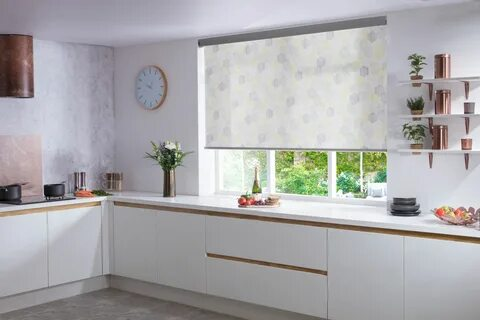
Faux wood. The moisture argument is clear enough that it doesn't require extensive qualification — real wood blinds in kitchens warp progressively in the steam environment above the hob, and the grease that settles on kitchen surfaces penetrates finishes over time. A quality faux wood blind in a kitchen in a finish that complements the cabinetry delivers everything a real wood blind would aesthetically while outlasting it considerably.
For kitchen-diners where the blind covers a large rear window away from the cooking zone, real wood is more viable — but the advice remains faux wood, because the cooking atmosphere in an open-plan kitchen-diner eventually reaches every surface in the room.
Bathrooms
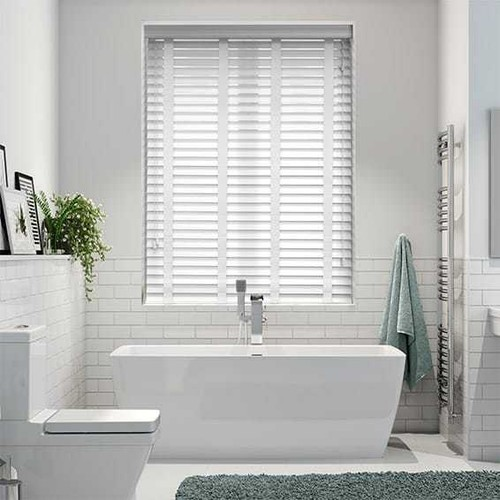
Faux wood, without reservation. This is the clearest case in the entire comparison. A real wood blind in a bathroom shower room will begin showing signs of moisture damage within twelve to eighteen months of regular use. The slats cup and bow, the finish breaks down at the edges where moisture enters end grain, and the warp becomes progressively more pronounced with each shower cycle.
A quality PVC faux wood blind in a bathroom is the correct product specification. There is no aesthetic argument strong enough to justify real timber in a room with daily steam exposure when the alternative provides indistinguishable appearance at normal viewing distances and indefinite dimensional stability.
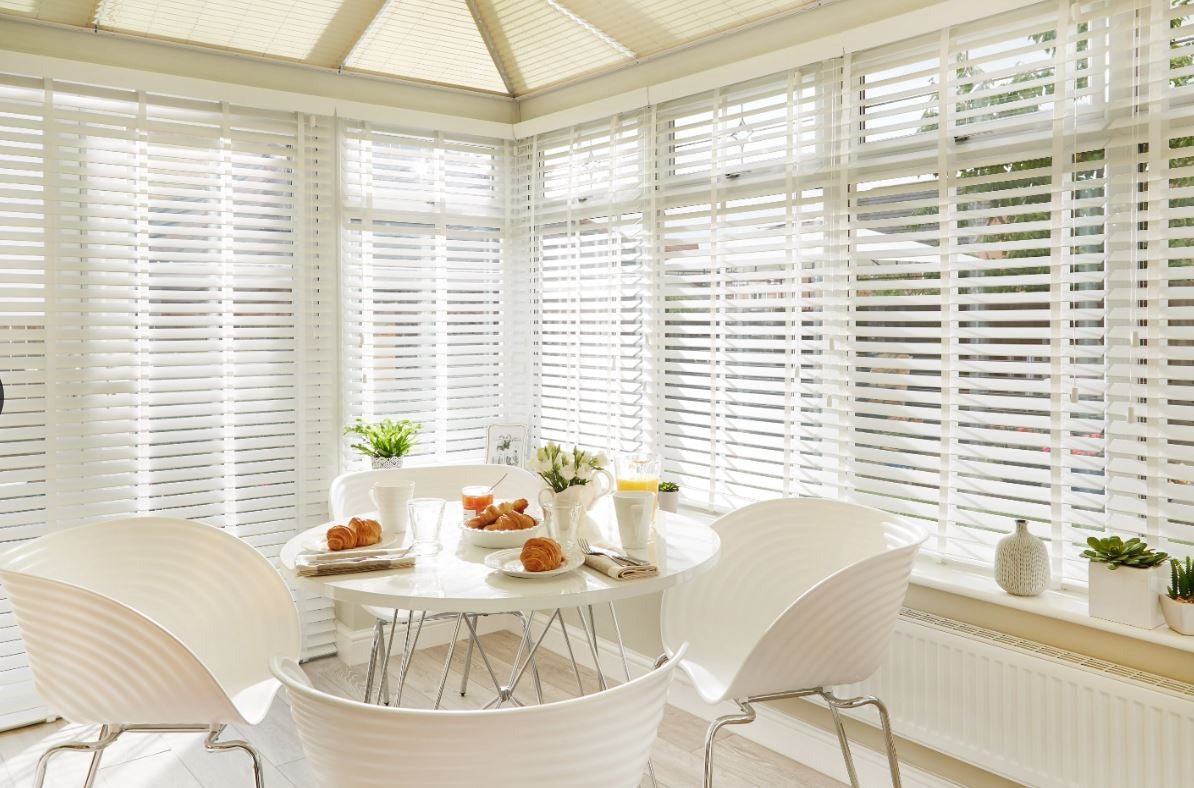
Conservatories
The UV exposure and temperature variation in a south-facing conservatory create a challenging environment for both materials, but faux wood handles it better.
Real wood in direct sunlight bleaches and checks over time — the surface finish degrades under UV, and the temperature swings between a hot summer afternoon and a cold winter morning cause expansion and contraction cycles that accumulate as dimensional stress. Quality real wood in a conservatory requires a robust UV-resistant finish and periodic maintenance to remain in good condition.
PVC faux wood is more UV-stable and dimensionally stable across temperature ranges. For a conservatory that sees significant solar exposure and seasonal temperature variation, faux wood is the lower-maintenance choice.
The Honest Verdict
There is no universally correct answer — but there is a decision framework that produces clear answers in specific situations.
Choose real wood blinds when the room is a dry living space — living room, bedroom, dining room, study — where the blind is a design element as much as a functional one, where the material authenticity of real timber contributes to the room's character, and where the budget accommodates the premium. The material quality of a well-made real wood blind in a dry room is genuine and lasting.
Choose faux wood when the room is a kitchen, bathroom, utility space, or conservatory where moisture resistance is a functional requirement. Choose faux wood for children's rooms where robustness matters more than material authenticity. Choose faux wood when the budget is the primary constraint and the visual difference at normal viewing distances — which in painted finishes is minimal — doesn't justify the real wood premium.
Choose faux wood for wide blinds where the weight of real timber becomes a practical consideration for the operating mechanism and for ease of daily use.
The faux wood blind started as a compromise. At current quality levels, it is a considered choice — the right answer in more rooms than its secondary status in the market suggests, and no longer a product that buyers need to apologise for choosing.