Skip to content


 Vertical Blinds
 Roman Blinds
 Roller Blinds
 Venetian Blinds
 Day and Night Blinds
 Skylight Blinds
 Children
 Wooden Blinds
 Curtains
 Blinds Accessories
 White
White Yellow
 Gold
Gold Green
Green Grey
Grey Pink
Pink Orange
 Animal
 Floral
 Geometric
 Striped
 Motorized Day and Night Blinds
 Motorized Roller Blinds
 No Drill Rollers
 Perfect Fit Wooden
 Perfect Fit Metal
 Thermal Blinds
 Better Sleep Blinds
 Cordless Blinds
 No Drill Blinds
 Blackout Blinds
 Waterproof Blinds
 Easy Wipe Blinds
 Taped Blinds
 Conservatory
 Office
 Kitchen
 Bathroom
 Dining Room
 Kids Room
 Living Room
 Bedroom
 Bay Window
 Conservatory Window
 Tild and Turn Window
 Bi Fold Window
 Roof of Skylight
 French Door
 Sliding Door
Blackout Blinds vs Blackout Curtains: Which Blocks More Light?
- by Mariam Labadze
 The question gets asked constantly and answered inconsistently. Blackout blinds or blackout curtains — which actually works better? The answer you receive depends heavily on who you ask: curtain retailers cite warmth and aesthetics, blind manufacturers cite precision and fit, and sleep consultants cite whatever they were last paid to endorse.
The honest answer requires separating the question into its component parts. Because "which blocks more light" isn't a single question — it's three questions simultaneously. Which fabric transmits less light? Which system creates fewer gaps? And which performs better under the specific conditions of a real bedroom rather than a controlled test environment?
Answering all three changes the conclusion considerably from what most buying guides suggest.
[toc]
How Blackout Performance Is Actually Measured
Before comparing the two formats, it's worth establishing what the measurement means — because the term blackout is applied to both products with very different degrees of rigour.
Fabric opacity is measured by light transmission percentage. A 0% transmission fabric allows no measurable light through the material itself. A 1% transmission fabric allows a small amount. Room-darkening fabrics sit at 3 to 5 percent. The distinction matters because 1% transmission sounds negligible until you're in a dark bedroom at 5am and the blind is backlit by a bright summer sky — at that contrast level, even fractional transmission is visible.
Genuine blackout fabric — blind or curtain — should carry a confirmed 0% transmission rating from an independent test. Marketing descriptions like "blackout effect," "near blackout," and "light-reducing" describe room-darkening performance rather than true blackout. The two are not interchangeable in a bedroom context.
Fabric transmission is only half the picture. The other half — and the half that most comparisons ignore — is gap coverage. A 0% transmission fabric with 20mm of uncovered window on each side is not a blackout solution. The gaps are.
The Gap Problem: Why This Is the Whole Argument
This is the central issue in the blinds versus curtains comparison, and once it's understood clearly, the rest of the comparison largely follows from it.
Where Curtains Create Gaps
A curtain hangs on a pole or track mounted above the window. The pole sits away from the wall on brackets, which means the curtain fabric hangs slightly in front of the window rather than flat against it. This creates a gap at the top — between the pole and the ceiling or wall above — and a gap at each side where the curtain doesn't extend fully to the wall.
The top gap is the most significant. Even a pole mounted close to the ceiling leaves a space above the curtain heading through which light enters the room and reflects off the ceiling. In a bedroom facing east at midsummer, this reflected ceiling light is often the first thing that registers before the curtain itself is obviously failing — a general brightening of the room from above before any direct light enters from the sides.
The side gaps depend on how far the curtain pole extends beyond the window frame on each side, and how fully the curtain is drawn. A pole that extends 150mm beyond the frame on each side, with the curtain drawn completely to the wall, leaves minimal side gaps. A pole that ends at the frame, with curtains pulled to their natural gathered position, leaves 50 to 100mm of uncovered wall on each side — which at the contrast levels of a dark room is a significant light source.
The central gap — where the two curtain panels meet when drawn — is the third persistent problem. Two panels meeting at the centre rarely create a perfect seal. They overlap in a loose gathered arrangement that, when backlit, shows as a brighter vertical stripe down the middle of the window.
The bottom gap is less of an issue if the curtain is floor-length and the fabric has sufficient weight to hang close to the floor, but a pooling curtain that sits on the floor creates more complete coverage than one that stops above it.
Where Blinds Create Gaps
A conventionally mounted blind — brackets fixed to the wall or reveal above the window — hangs in front of the glass with a gap at each side between the blind's edge and the wall. The precise gap depends on the bracket depth and the window reveal dimensions, but 10 to 20mm on each side is typical.
There is no central gap — a roller blind is a single piece of fabric. There is, however, a potential bottom gap if the bottom rail is not weighted sufficiently to hold the fabric flat against the window reveal.
The top of a conventionally mounted blind is another light path. The roller tube or headrail sits below its brackets, with a gap above where light can enter over the top of the blind.
The Perfect Fit Solution
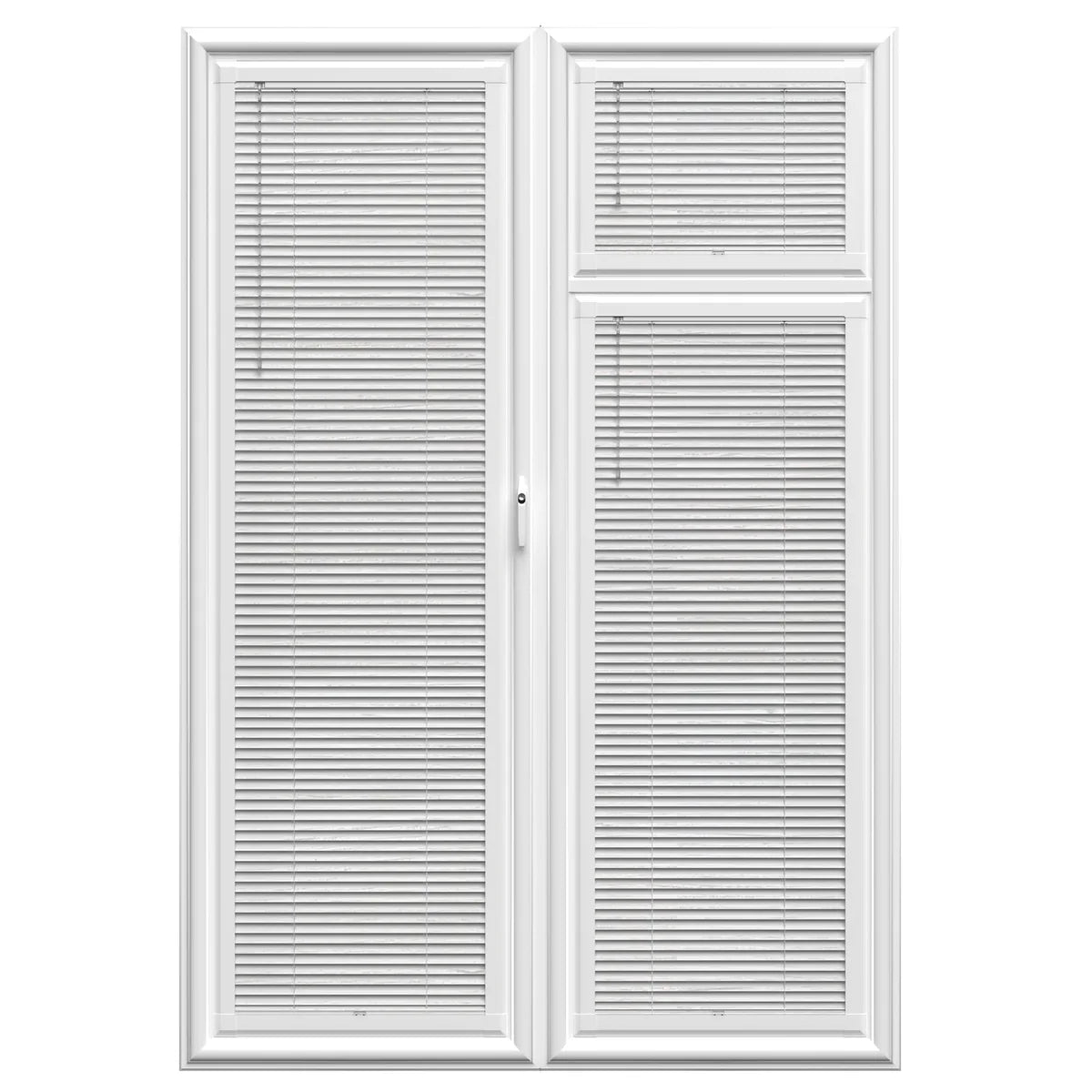
The structural solution to the gap problem — for blinds — is the perfect fit mounting system. A perfect fit blind clips directly into the UPVC glazing bead and covers the glass edge to edge with no gap at any side. There is no gap at the top, sides, or bottom because the blind occupies the same space as the glass within the frame. The light exclusion is structural rather than dependent on precise hanging or careful installation.
No equivalent solution exists for curtains. The fabric-on-a-pole format is inherently gap-prone because the pole must sit in front of the window rather than within it, and gathering fabric cannot achieve the geometric precision of a flat surface occupying a fixed opening.
Fabric Performance: Blinds vs Curtains
Blackout Blind Fabrics
Blackout roller blind fabrics achieve their opacity through a coating or laminate applied to the back of the woven material — a separate layer bonded to the fabric that blocks light transmission. When new, quality blackout coatings achieve 0% transmission reliably. The limitation is longevity — repeated rolling and unrolling stresses the coating at the roll point, and over years of daily use pinholes or cracking can develop. The blackout performance of a coated roller blind fabric gradually diminishes, though the timeline depends significantly on fabric quality.
Honeycomb blackout blind fabrics achieve opacity through structural cell wall density rather than surface coating. Because the opacity is a material property rather than an applied treatment, it doesn't degrade with use. The performance in year five is identical to day one — which is a meaningful durability advantage over coated alternatives.
Blackout Curtain Fabrics
Blackout curtains use either a blackout lining sewn behind the main fabric, or a blackout interlining — a thicker, denser layer between the face fabric and lining — that combines thermal insulation with light blocking.
A quality blackout-lined curtain achieves 0% fabric transmission when the lining is intact and undamaged. The challenge is that curtain fabrics are not under the same mechanical stress as roller blind coatings — the fabric hangs and gathers rather than rolling under tension — so the fabric itself rarely fails as a blackout element.
The curtain's failure mode is almost always the gaps rather than the fabric. The lining can be perfect and the curtain can still fail to darken the room adequately because the mounting arrangement creates light paths that the fabric doesn't cover.
Thermal Lining
This is one area where curtains have a genuine advantage over most blind formats. A heavily interlined blackout curtain adds meaningful thermal mass to the window — the multiple layers of fabric, lining, and interlining trap a substantial air volume and resist heat transfer. On a cold winter night, a well-lined curtain contributes noticeably to room warmth.
The thermal performance of a honeycomb blackout blind is comparable to — and in sealed perfect fit format, arguably better than — a thermally lined curtain, because the cellular air trap is sealed on all four sides and cannot be bypassed by convection around the edges. But a standard blackout roller blind in a conventional mounting provides no meaningful thermal benefit beyond slightly reducing radiant heat loss through the fabric layer.
Installation: How Mounting Method Affects Performance
Curtain Installation Variables
The blackout performance of a curtain system depends significantly on installation decisions that are made at fitting time and are largely independent of fabric quality.
Pole or track position: A pole or track mounted at ceiling height, as close to the ceiling as brackets allow, minimises the top gap. A pole mounted 100mm above the window head — a common decorator's choice for making windows appear taller — creates a 100mm gap above the curtain through which light enters freely.
Pole extension beyond the frame: A pole that extends 200mm or more beyond the window frame on each side allows the drawn curtain to clear the window completely before gathering, which minimises side gaps when the curtain is closed. A pole that ends at the frame means the curtain gathers partially over the glass rather than fully to one side, with gaps at the edges.
Curtain heading and return: A curtain with a wall return — a section of fabric that turns back to the wall at each end of the pole — eliminates side gaps more completely than a curtain that simply hangs and gathers. Eyelet headings with returns perform this function poorly; pencil pleat or pinch pleat headings with a wall bracket at each end perform it better.
Floor clearance: A curtain that pools slightly on the floor creates more complete bottom coverage than one that stops above it. A puddle of 20 to 30mm eliminates the bottom gap entirely.
Getting all of these variables right simultaneously requires specific knowledge and careful installation. Many curtain installations get some of them right and others wrong, which is why curtain blackout performance varies so widely between apparently similar products.
Blind Installation Variables
A conventionally mounted roller or Roman blind has fewer installation variables but one persistent limitation: the gap at the sides created by the bracket offset from the wall is geometrically unavoidable.
Extending the bracket positions beyond the window frame on each side reduces the gap width — a blind that's 100mm wider than the window frame on each side covers more of the surrounding wall — but increases the visual bulk of the blind above the window and requires wall space on both sides.
The perfect fit system eliminates all of these installation variables by sitting within the frame. There are no bracket positions to optimise, no gaps to minimise, no installation decisions that affect the blackout outcome. The performance is determined by the product design rather than the installer's choices.
Direct Performance Comparison
In a Controlled Environment
If both products are fitted perfectly — the curtain on a ceiling-height pole with full wall returns, floor-pooling panels, complete central overlap, and 0% transmission fabric; the blind in a perfect fit frame with 0% transmission fabric — the blind performs marginally better on light exclusion. The geometric precision of a flat surface occupying a fixed opening is more complete than the gathered and layered arrangement of fabric panels, even well-fitted ones.
The honeycomb blind in a perfect fit frame performs best of all formats tested — it addresses fabric transmission, edge gaps, and thermal light paths simultaneously in a way that no other single-product solution matches.
In Real-World Bedrooms
The performance gap between blind and curtain widens considerably in real-world conditions. Most curtain installations don't achieve the ideal installation described above — poles are mounted at decorator's height rather than ceiling height, extensions are modest, and central overlaps are incomplete. Most blackout curtains in UK bedrooms admit light through the top, the sides, or the centre even when they're expensive products correctly described as blackout.
Most roller blind installations also underperform their potential — the side gaps from bracket-mounted blinds are consistent and unavoidable. But a perfect fit blackout blind in a UPVC window achieves its designed performance without the installation sensitivity that curtains require. It either fits correctly or it doesn't — there are no intermediate states where it fits but underperforms.
The practical conclusion from real-world bedroom performance is that perfect fit blinds are more reliably effective than curtains because their performance is less dependent on installation precision.
Where Curtains Win
Aesthetics and Warmth
There is no blind format that replicates what fabric panels do to a bedroom. The softness, the movement, the acoustic dampening, the sense of occasion when heavy curtains are drawn — these are qualities that blinds don't offer and that matter in a bedroom as a designed space rather than just a functional one.
For rooms where the visual character of the window treatment is important alongside its blackout function, curtains contribute something genuine that no blind replaces.
Large or Irregular Windows
For very large windows, arched windows, or windows where the frame geometry prevents a standard blind mounting, curtains are often the only practical option. The fabric-on-a-pole format is adaptable to unusual window shapes and sizes in a way that frame-mounted blind systems are not.
Period Properties With Timber Frames
In Victorian or Edwardian properties where UPVC perfect fit systems aren't compatible with the window frame type, curtains with careful installation often outperform the available no-drill blind alternatives. A well-installed curtain on a ceiling-height pole with wall returns is a more complete blackout solution than a tension rod blind in a timber sash recess.
Where Blinds Win
UPVC Windows
For UPVC casement, tilt-and-turn, and sash windows — the dominant window type in UK homes built since the mid-1980s — a perfect fit blackout blind provides more reliable and more complete blackout performance than curtains on the same window. The structural elimination of gaps is not something careful curtain installation can fully replicate.
Rented Properties
No-drill perfect fit blackout blinds require no fixings, create no deposit liability, and can be removed and reinstalled at a new property. Curtains in rented properties require a pole or track that either uses existing brackets — which may not be ideally positioned — or new brackets that create deposit risk.
Simplicity and Consistency
A perfect fit blind performs identically every time it's lowered. A curtain performs differently depending on how carefully it's drawn, whether the central overlap is complete, whether it's shifted slightly from its ideal position. For anyone who values consistent blackout without a nightly ritual of adjusting panels and checking gaps, the blind wins on practical reliability.
Tilt-and-Turn Windows
The perfect fit blind on a tilt-and-turn window allows simultaneous ventilation and blackout — the blind tilts with the window and maintains coverage with the window open. No curtain configuration achieves this. For summer nights when the choice between air and darkness is otherwise forced, this is a decisive practical advantage.
The Combination Approach
The most complete blackout solution for a bedroom — and the approach that gives the best result on every dimension simultaneously — is both.
A perfect fit honeycomb blackout blind within the frame handles the functional brief entirely. Edge-to-edge coverage, 0% fabric transmission, no installation gaps, thermal insulation. The blackout performance is complete and consistent.
Curtains outside the frame — on a pole or track mounted independently of the blind — add the aesthetic quality, warmth, and acoustic contribution that fabric panels provide and that no blind replicates. Because the blind is doing all the functional work, the curtains can be chosen for their appearance rather than their blackout credentials. Unlined linen, patterned cotton, velvet — whatever suits the room — without any requirement that the curtain itself performs a blackout function.
The blind and the curtains operate independently. Either can be changed without affecting the other. For a bedroom where both sleep quality and design quality matter — which describes most well-considered bedrooms — this layered approach is the most satisfying outcome of the blinds versus curtains comparison.
Verdict
For pure blackout performance — the question the title asks — blinds win, provided they're fitted correctly. A perfect fit blackout blind on a UPVC window eliminates gaps structurally. A honeycomb blackout blind in the same system adds thermal performance that curtains only approach with heavy interlining. Neither requires the careful installation precision that curtain blackout performance depends on.
Curtains win on aesthetics, adaptability to unusual windows, and the specific quality of warmth and softness that fabric panels contribute to a room's character. They're the better choice for period properties with non-UPVC frames, for rooms where the window treatment is a design feature rather than a background element, and for anyone who wants the distinctive quality that only curtains provide.
The honest conclusion is that the question presents a false choice for most bedrooms. The best blackout bedroom uses both — a perfect fit blind for function, curtains for character. Treating them as competing options means choosing between sleep quality and design quality unnecessarily, when the combination delivers both without compromise.