Skip to content


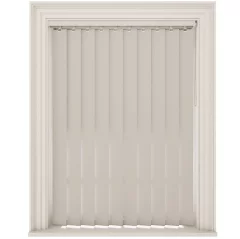 Vertical Blinds
 Roman Blinds
 Roller Blinds
 Venetian Blinds
 Day and Night Blinds
 Skylight Blinds
 Children
 Wooden Blinds
 Curtains
 Blinds Accessories
 White
White Yellow
 Gold
Gold Green
Green Grey
Grey Pink
Pink Orange
 Animal
 Floral
 Geometric
 Striped
 Motorized Day and Night Blinds
 Motorized Roller Blinds
 No Drill Rollers
 Perfect Fit Wooden
 Perfect Fit Metal
 Thermal Blinds
 Better Sleep Blinds
 Cordless Blinds
 No Drill Blinds
 Blackout Blinds
 Waterproof Blinds
 Easy Wipe Blinds
 Taped Blinds
 Conservatory
 Office
 Kitchen
 Bathroom
 Dining Room
 Kids Room
 Living Room
 Bedroom
 Bay Window
 Conservatory Window
 Tild and Turn Window
 Bi Fold Window
 Roof of Skylight
 French Door
 Sliding Door
Replacement Vertical Blind Slats: How to Measure and Swap Them
- by Mariam Labadze
 Yes, you can buy replacement vertical blind slats on their own and fit them to your existing headrail, which saves you buying a whole new blind when the fabric has faded, torn or warped. Measure your current slat length and width, order the same size in a fabric you like, then hook each new slat onto its carrier and clip the bottom weights and chain across. The job takes minutes per slat.
Vertical blinds are built to be serviced this way. The headrail, carriers, weights and connecting chain usually outlast the fabric by years, so when the louvres start to look tired there is rarely any need to replace the mechanism above them. Swapping the slats alone is cheaper, quicker and far less disruptive. What follows is how to measure accurately, choose the right size, and fit the new slats without fuss.
[toc]
Can you buy replacement vertical blind slats separately?
You can, and it is one of the most sensible upgrades for a tired vertical blind. Fabric takes the brunt of daily life: sunlight bleaches the colour, kitchen and bathroom moisture can mark it, and the bottom edges fray where hands and pets brush past. The headrail and its moving parts, meanwhile, tend to keep working fine.
Buying replacement vertical blind slats means you keep the track that is already screwed to your wall or ceiling and simply refresh what shows. The new louvres hook straight onto the existing carriers, so there is no drilling, no rebalancing the track and no need to touch the fitting at all.
It is also a chance to change the look. If you fancy a different colour or a slightly warmer tone, refreshing the fabric is far easier than you might think. Our guide on choosing the right colour vertical blinds is a good starting point if you want the new slats to shift the mood of the room rather than just match the old ones.
When to replace slats and when to replace the blind
Replace just the slats if the headrail slides smoothly, the carriers rotate together when you twist the wand or chain, and only the fabric looks worn. Replace the whole blind if the track itself is cracked, the carriers no longer turn in unison, or the headrail is the wrong length for the window. In most homes it is the fabric that goes first, so slat-only replacement is the usual answer.
How to measure vertical blind slats
Getting the measurements right is the whole game. Two dimensions matter: the width of each slat and the drop, or length, from the top of the slat to the bottom.
For width, take an existing slat off its carrier and lay it flat. Most domestic vertical blinds use one of two common widths, and yours will match one of them. Measure across the flat face rather than guessing, because the two sizes are close enough to confuse by eye. Ordering the wrong width means the slats will not sit correctly across the track or will overlap awkwardly.
For length, measure from the very top of the slat, where the hook or hole engages the carrier, down to the bottom edge where the weight clips on. Measure the fabric slat, not the gap to the floor, and take the figure from a slat that has not stretched or curled. If your old slats have dropped over time, check the length against the window rather than assuming the worn slat is accurate.
A few practical notes:
-
Measure two or three slats and use the most consistent figure, since a single distorted louvre can throw you off.
-
Note the number of slats on the track so you order the full set plus a spare or two.
-
Decide whether you want the new slats to sit just above the floor or the windowsill, and adjust the length order accordingly if you are changing the drop.
If you are ever unsure which of the standard widths you have, measuring a clean flat slat with a steel rule removes all doubt. It is a five-minute check that prevents a return.
Are vertical blind slats a standard size?
Largely, yes. The domestic market settled on a small number of standard slat widths years ago, which is why replacement louvres are so widely available and easy to match. That standardisation is exactly what makes slat-only replacement practical: your carriers were built for a common width, and new slats are made to the same specification.
Length is where you have freedom. Slats are supplied to be cut or ordered to your drop, so you are not tied to a fixed length the way you are with width. Whether your window is short and wide or full-height, the slats can be sized to suit. That combination, standard width and made-to-order length, is what lets a fresh set of vertical blind slats drop straight onto an existing headrail.
Because the width is standard, the small hardware pieces are interchangeable too. Bottom weights and connecting chains from your old set will usually work with new slats of the same width, though it is worth having spares to hand in case any are brittle with age.
How to fit replacement vertical blind slats
Fitting is genuinely quick once the slats arrive. Rotate the louvres to the flat, open position using the wand or chain so every carrier faces you square on. This gives you clear access to each hook.
Take an old slat down first by unclipping the bottom weight, sliding the chain free, and lifting the top hook off the carrier. Then reverse the process with the new one: hook the top onto the carrier, feed the bottom weight into the pocket at the base of the slat, and connect the chain across to its neighbours. Work along the track one slat at a time so you keep the order and spacing even.
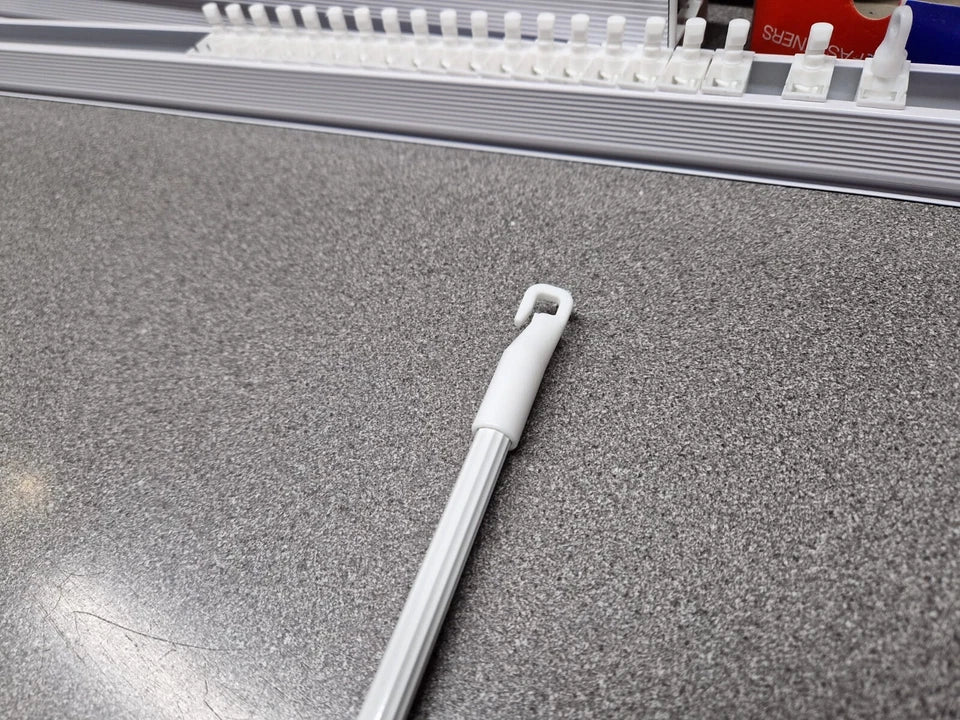
The connecting chain along the bottom keeps the slats evenly spaced and stops them swinging. If the little clips that join the chain to each weight are worn or missing, a pack of blind cord connector clips is an inexpensive way to get everything hanging straight again. Once every slat is on and the chain is linked end to end, twist the wand to check they all rotate together.
Choosing the right fabric while you are at it
Since you are refreshing the louvres anyway, think about performance, not just colour. If the window faces a bedroom or a bright aspect, blackout vertical blind slats will cut far more light than a standard weave and help with early mornings and glare. For a kitchen or bathroom, a fabric that shrugs off moisture makes more sense. It costs no more effort to choose the right fabric now, and you get a blind that suits the room rather than one that merely looks new.
If any of the smaller headrail parts need replacing alongside the slats, the wider blinds accessories range covers weights, chains and carriers so you can bring the whole blind back to as-new condition in one go.
Frequently asked questions
Can you buy replacement vertical blind slats?
Yes. Slats are sold separately from the headrail, so you can refresh worn or faded louvres without buying a new blind. They hook onto your existing carriers, which means no drilling and no changes to the fitting, just a straight swap of the fabric that shows.
How do you measure vertical blind slats?
Measure the width across the flat face of a single slat, and the length from the top hook down to the bottom edge where the weight clips on. Take the figures from a slat that has not curled or stretched, and check a couple of louvres for a consistent reading before you order.
Are vertical blind slats a standard size?
Widths are standardised across the domestic market, which is why replacement slats are so easy to match to an existing track. Length is made to order, so you can set the drop to suit your window while the width slots straight onto your current carriers.