Skip to content


 Vertical Blinds
 Roman Blinds
 Roller Blinds
 Venetian Blinds
 Day and Night Blinds
 Skylight Blinds
 Children
 Wooden Blinds
 Curtains
 Blinds Accessories
 White
White Yellow
 Gold
Gold Green
Green Grey
Grey Pink
Pink Orange
 Animal
 Floral
 Geometric
 Striped
 Motorized Day and Night Blinds
 Motorized Roller Blinds
 No Drill Rollers
 Perfect Fit Wooden
 Perfect Fit Metal
 Thermal Blinds
 Better Sleep Blinds
 Cordless Blinds
 No Drill Blinds
 Blackout Blinds
 Waterproof Blinds
 Easy Wipe Blinds
 Taped Blinds
 Conservatory
 Office
 Kitchen
 Bathroom
 Dining Room
 Kids Room
 Living Room
 Bedroom
 Bay Window
 Conservatory Window
 Tild and Turn Window
 Bi Fold Window
 Roof of Skylight
 French Door
 Sliding Door
How to Replace Vertical Blind Slats: Step-by-Step Guide
- by Mariam Labadze
 Vertical blinds are remarkably long-lived — the headrail and carrier mechanism can last twenty years or more. The slats, however, are a different story. Fabric or PVC louvres take daily handling, exposure to sunlight, and occasional cleaning abuse, and individual slats do break, warp, discolour, or simply go missing over time. The good news is that replacing vertical blind slats is one of the simplest DIY tasks you can undertake on a window covering — and buying replacement slats is far cheaper than replacing an entire blind. This step-by-step guide walks you through everything you need to know.
Can You Replace Individual Vertical Blind Slats?
Yes — individual slats (also called louvres) can be replaced without removing the entire blind. The headrail and carrier clips remain in place; you simply detach the damaged slat and clip a new one in. The only requirement is that the replacement slat matches the width, length, and fabric type of your existing blind as closely as possible, or that you replace all slats at once for a perfectly matched result.
If your blind is an older model with an unusual slat width (89 mm and 127 mm are the two standard UK widths), or a discontinued fabric pattern, matching a single replacement slat perfectly can be challenging. In that case, replacing all slats at once with a new matching set is usually the most practical and visually consistent solution.
What You Will Need
Before starting, gather: the replacement slats (pre-cut to the correct drop length if possible, or a cutter if you need to trim to length), a step ladder or stable platform to reach the headrail comfortably, and a flat surface to lay slats flat while you work. No tools are required for most clip-based systems — the slats and bottom chain weights detach and reattach by hand.
Step 1: Remove the Damaged Slat
Start by rotating all the slats to the open (flat) position so they are all aligned facing the same way. Find the damaged slat and locate its position in the headrail. Each slat hangs from a carrier clip — a small plastic or metal clip that hooks through a hole or slot at the top of the slat.
To remove the slat, simply grasp it firmly at the top and lift it upward until the top hook clears the carrier clip. The slat will drop free. If there is a bottom weight chain running through a hole at the base of each slat, you will also need to thread the slat off the chain — unhook the chain from the neighbouring slats' bottom loops if necessary.
💡 Tip: Lay the removed slat on a flat surface. Use it as a template to measure the correct drop length and hole spacing for your replacement slat.
Step 2: Check the Carrier Clip
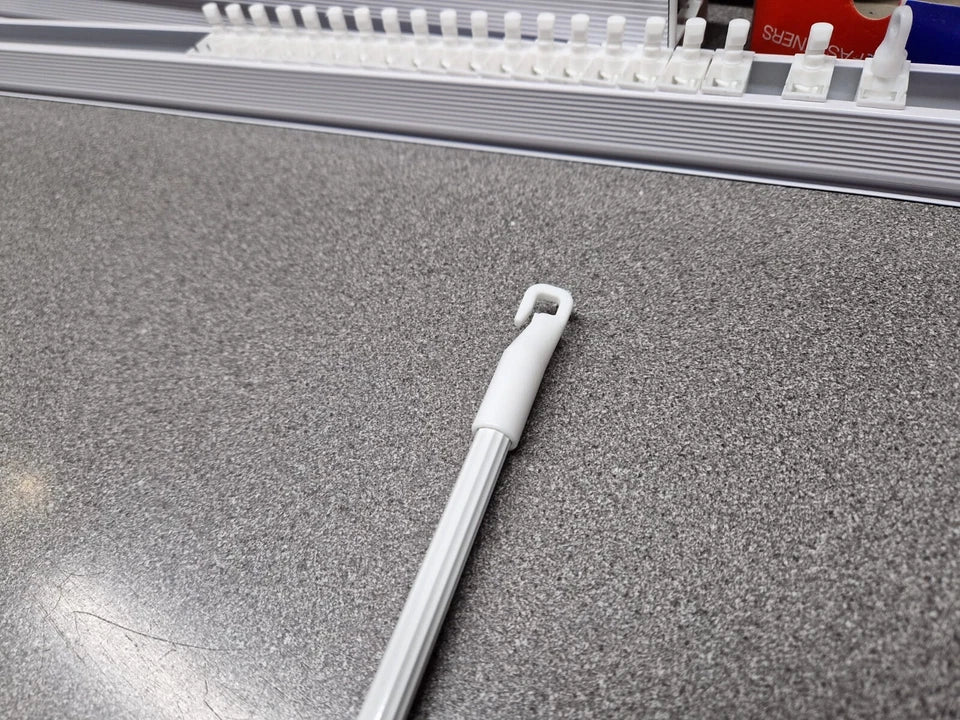
Once the slat is removed, inspect the carrier clip. These small clips are frequently the actual cause of slat problems — a cracked or broken clip cannot hold the slat at the correct angle and causes it to swing loose or fail to rotate. If the clip is damaged, it must be replaced before fitting the new slat. Replacement carrier clips for most standard 89 mm and 127 mm headrails are inexpensive and widely available.
Find replacement carrier clips and other vertical blind spare parts in our blinds accessories section.
Step 3: Prepare the Replacement Slat
If your replacement slat arrives pre-drilled with the correct hole at the top and bottom slot for the chain, it is ready to fit. If it arrives undrilled, you will need to punch or drill the top hook hole at the same distance from the top as your existing slats — typically 15–20 mm from the top edge for 89 mm slats.
If the replacement slat is too long, it can be trimmed with a sharp pair of scissors (for fabric slats) or a fine-tooth saw or guillotine cutter (for PVC slats). Always cut from the bottom edge, not the top, to preserve the pre-drilled hole. Cut square across the slat and sand or clip off any rough edges.
Step 4: Fit the New Slat
Thread the bottom of the replacement slat through the bottom weight chain if applicable — this may require unclipping the chain from adjacent slats temporarily. Then hook the top hole of the slat onto the carrier clip, pressing firmly until it clicks into place. The slat should hang freely and rotate smoothly when you operate the control chain.
If the slat feels stiff to rotate, check that the top hook is correctly seated in the carrier — it is easy to catch the slat on the edge of the clip rather than fully engaging the hook. Remove and refit if necessary.
Step 5: Check the Alignment
Once the new slat is fitted, rotate the entire blind to the closed position and check that the new slat sits flush with its neighbours. Any slight difference in height (caused by a slightly longer or shorter slat) will be visible when the blind is closed. Adjust by trimming the bottom of the slat by a millimetre or two if necessary.
Also check the bottom weight chain. In most systems, a small plastic or metal weight hangs from a bottom hook at the base of each slat. These weights keep the slats from blowing in a breeze and help them hang straight. If the weight is missing from the replaced slat, fit a replacement weight before finishing.
Replacement bottom weights and chain links are available in our blinds accessories collection alongside full slat replacement sets.
Replacing All Slats at Once
If multiple slats are damaged, stained, or faded — or if you want to change the colour or fabric of your vertical blind without replacing the entire system — replacing all slats at once is a more straightforward process than replacing them individually. It also gives a perfectly consistent result.
To replace all slats, simply repeat the removal process for each slat in sequence, working from one end to the other. Thread the new slats onto the bottom chain (if applicable) before hanging them, which makes it easier to manage the chain as a unit.
Browse the full range of vertical blind slats and replacement parts at 1ClickBlinds, available in 89 mm and 127 mm widths.
When to Replace vs Repair
Replacing slats makes sense when the headrail and carrier mechanism are still functioning correctly and only the fabric has deteriorated. If the carrier clips are widely broken, the drive gear is damaged, or the control chain has snapped, a full blind replacement is often more economical than sourcing multiple mechanical parts.
A rough guide: if more than a third of the carriers need replacing, or if the headrail itself is warped or cracked, invest in a new blind. If the mechanism is sound and only the slats are damaged, replacement slats are the right solution.
For a full new vertical blind system, explore our complete vertical blinds collection including made-to-measure options for non-standard windows.
Summary
Replacing vertical blind slats is quick, inexpensive, and requires no tools in most cases. Remove the damaged slat from its carrier clip, check and replace the clip if necessary, prepare the new slat to the correct length, and clip it into place. The entire process takes less than five minutes per slat once you have done it once. For widespread slat damage, replacing all slats simultaneously gives the most consistent and professional result.