Skip to content


 Vertical Blinds
 Roman Blinds
 Roller Blinds
 Venetian Blinds
 Day and Night Blinds
 Skylight Blinds
 Children
 Wooden Blinds
 Curtains
 Blinds Accessories
 White
White Yellow
 Gold
Gold Green
Green Grey
Grey Pink
Pink Orange
 Animal
 Floral
 Geometric
 Striped
 Motorized Day and Night Blinds
 Motorized Roller Blinds
 No Drill Rollers
 Perfect Fit Wooden
 Perfect Fit Metal
 Thermal Blinds
 Better Sleep Blinds
 Cordless Blinds
 No Drill Blinds
 Blackout Blinds
 Waterproof Blinds
 Easy Wipe Blinds
 Taped Blinds
 Conservatory
 Office
 Kitchen
 Bathroom
 Dining Room
 Kids Room
 Living Room
 Bedroom
 Bay Window
 Conservatory Window
 Tild and Turn Window
 Bi Fold Window
 Roof of Skylight
 French Door
 Sliding Door
Motorised Day and Night Blinds: Smart Home Upgrade Worth It?
- by Mariam Labadze
 Day and night blinds have become one of the most popular window coverings in UK homes, thanks to their clever alternating fabric strips that let you shift between sheer light filtering and full privacy in seconds. But what happens when you add a motor to that equation? Motorised day and night blinds promise hands-free convenience, smart home integration, and a touch of luxury — yet they come at a higher price point than their manual counterparts. So the question remains: are they genuinely worth the investment?
In this comparison, we break down everything you need to know — from how motorised day and night blinds actually work, to whether the convenience justifies the cost for your household.
Quick Answer: Motorised day and night blinds use a built-in motor to raise, lower, and transition between sheer and opaque fabric strips via remote control, wall switch, or smartphone app. They integrate with smart home systems like Alexa and Google Home, allowing voice control and automated schedules. While they cost more upfront than manual versions, they offer significant convenience — particularly for hard-to-reach windows, large installations, and households looking to automate light and privacy control.
How Motorised Day and Night Blinds Work
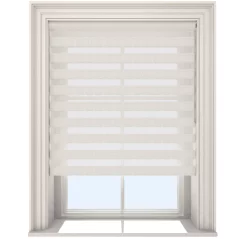
The basic mechanism is the same as a standard day and night blind — two layers of alternating sheer and opaque fabric strips that overlap. When the strips align, light filters through. When they offset, the opaque sections overlap to block light and provide privacy.
The motorised element replaces the manual chain or cord with a small electric motor housed inside the headrail. This motor controls both the up-and-down movement and the transitioning of the fabric strips. You operate them using a remote control, a wall-mounted switch, or — with smart-enabled models — an app on your phone.
Battery-Powered vs Mains-Powered Motors
This is one of the first decisions you will face, and it has practical implications for installation and ongoing use.
Battery-powered motors are by far the easier option to install. There is no wiring involved, which means no electrician and no disruption to your walls. Most battery motors use a rechargeable lithium-ion battery that lasts anywhere from six months to over a year depending on usage. When the battery runs low, you simply recharge it with a USB cable. This makes battery-powered models ideal for renters or anyone who wants a straightforward retrofit.
Mains-powered motors require a permanent power connection, which typically means routing a cable to the blind or having a socket nearby. The advantage is that you never need to think about charging — the blind is always ready. Mains-powered motors also tend to be slightly more powerful, which can matter for wider or heavier blinds. If you are building a new home or renovating, mains power is worth considering from the outset.
Manual vs Motorised: A Direct Comparison
To help you weigh up the two options, here is a straightforward look at how they compare across the factors that matter most.
Ease of Use
Manualday and night blindsuse a chain or cord mechanism. They work perfectly well and most people find them intuitive. However, adjusting multiple blinds across a room — or reaching a blind behind furniture or above a door — can be a minor inconvenience that adds up over time.
Motorised versions eliminate this entirely. A single press adjusts the blind to your preferred position. If you have several motorised blinds, many systems let you group them so they all move together.
Safety
Corded blinds present a well-documented strangulation risk for young children. While breakaway chains and cord cleats reduce this risk,cordless blinds— including motorised options — remove it altogether. If child safety is a priority in your household, motorised blinds offer genuine peace of mind.
Aesthetics
Without a dangling chain or cord, motorised blinds look noticeably cleaner and more streamlined. The headrail is typically a touch larger to accommodate the motor, but the overall appearance is sleeker. For modern interiors where clean lines matter, this is a meaningful upgrade.
Price
This is where the gap is most apparent. A manual day and night blind might cost between £25 and £60 depending on size and fabric. Amotorised day and night blindtypically starts from around £80 and can reach £150 or more for larger sizes with smart home connectivity. You are paying for the motor, the remote or app control, and the technology built into the headrail.
That said, the price gap has narrowed considerably over the past few years. Motorised blinds are no longer the luxury-only product they once were.
Smart Home Integration: Alexa, Google Home, and Beyond
One of the strongest arguments for going motorised is smart home compatibility. Many modern motorised day and night blinds connect via Wi-Fi or Bluetooth to your existing smart home ecosystem.
What You Can Actually Do
-
Voice control: "Alexa, close the bedroom blinds" or "Hey Google, set the living room blinds to 50%." It sounds like a gimmick until you use it regularly — then it becomes second nature.
-
App control: Adjust blinds from anywhere using your smartphone. Useful when you are away from home and want to give the impression someone is in, or when you are in bed and forgot to close the kitchen blinds.
-
Scenes and routines: Integrate your blinds into broader smart home routines. For example, your morning routine could gradually open the blinds at 7am, turn on the coffee machine, and start your favourite playlist.
-
Sunrise and sunset automation: Some apps allow blinds to follow the sun, opening at dawn and closing at dusk — adjusting automatically as the days lengthen and shorten through the year.
Scheduling and Automation
Programmable schedules are arguably the most practical feature of motorised blinds. You can set your blinds to close at a specific time each evening for privacy, or open gradually in the morning as a gentle wake-up alternative to an alarm. For shift workers or anyone with an irregular routine, different schedules can be set for different days of the week.
From an energy efficiency standpoint, automated blinds can help regulate indoor temperatures. Closing blinds during the hottest part of a summer afternoon keeps rooms cooler without running air conditioning. In winter, opening south-facing blinds during sunny hours lets solar gain warm your rooms naturally.
Who Benefits Most from Motorised Day and Night Blinds?
Motorised blinds are not essential for everyone, but certain households will get significantly more value from them:
-
Homes with hard-to-reach windows: Tall windows, skylights, or blinds positioned behind sofas and beds are far easier to operate with a remote or voice command.
-
Large open-plan spaces: If you have four or five blinds across a wide living area, adjusting them individually with chains is tedious. Grouping them on a single remote is a genuine time-saver.
-
Families with young children: Removing cords from the equation is the safest option available.
-
Smart home enthusiasts: If you already use Alexa, Google Home, or Apple HomeKit for lighting and heating, adding blinds to your setup is a logical next step.
-
Anyone with mobility challenges: For older homeowners or those with limited dexterity, motorised operation removes a physical barrier.
Installation Considerations
Battery-powered motorised day and night blinds install in much the same way as manual ones — brackets fixed to the wall or window frame, blind clicked into place. The only addition is pairing the remote control or connecting the blind to your Wi-Fi network, which typically takes a few minutes.
If you preferno-drill blinds, some motorised models are compatible with tension-fit or adhesive brackets, though the added weight of the motor means you should check weight limits carefully.
At 1ClickBlinds, the range of motorised day and night blinds includes both battery and rechargeable options, with straightforward fitting instructions included. Most customers complete the installation themselves without professional help.
Maintenance and Longevity
Modern blind motors are designed to last. Most manufacturers rate them for tens of thousands of cycles, which translates to many years of daily use. Battery-powered motors will need periodic recharging — typically every six to twelve months — but this takes just a few hours via USB.
The fabric itself requires the same care as a manual day and night blind: occasional dusting or a gentle wipe with a damp cloth. The motor mechanism is sealed inside the headrail and requires no user maintenance.
Frequently Asked Questions
Can I still operate motorised day and night blinds manually?
Most motorised models include a manual override, allowing you to adjust the blind by hand if the battery dies or there is a power cut. However, the primary design is for motorised operation, and the manual movement may feel stiffer than a dedicated manual blind.
Are motorised day and night blinds noisy?
Modern motors are remarkably quiet. You will hear a soft hum as the blind moves, but it is barely noticeable — certainly not loud enough to disturb sleep or conversation. Earlier generations were noisier, but current technology has largely eliminated this concern.
Do I need a smart home hub to use motorised blinds?
Not necessarily. Many motorised blinds come with their own remote control and work independently. Smart home integration via Alexa or Google Home is an optional extra that requires a Wi-Fi bridge or built-in Wi-Fi, depending on the model. You can enjoy motorised convenience without any smart home setup at all.
How long do batteries last in battery-powered motorised blinds?
Battery life depends on usage, but most rechargeable lithium-ion batteries last between six months and a year with typical daily use (two to four operations per day). Recharging takes around four to six hours via a standard USB cable.