Skip to content


 Vertical Blinds
 Roman Blinds
 Roller Blinds
 Venetian Blinds
 Day and Night Blinds
 Skylight Blinds
 Children
 Wooden Blinds
 Curtains
 Blinds Accessories
 White
White Yellow
 Gold
Gold Green
Green Grey
Grey Pink
Pink Orange
 Animal
 Floral
 Geometric
 Striped
 Motorized Day and Night Blinds
 Motorized Roller Blinds
 No Drill Rollers
 Perfect Fit Wooden
 Perfect Fit Metal
 Thermal Blinds
 Better Sleep Blinds
 Cordless Blinds
 No Drill Blinds
 Blackout Blinds
 Waterproof Blinds
 Easy Wipe Blinds
 Taped Blinds
 Conservatory
 Office
 Kitchen
 Bathroom
 Dining Room
 Kids Room
 Living Room
 Bedroom
 Bay Window
 Conservatory Window
 Tild and Turn Window
 Bi Fold Window
 Roof of Skylight
 French Door
 Sliding Door
Vertical Blinds for Large Windows and Patio Doors: Full Guide
- by Mariam Labadze
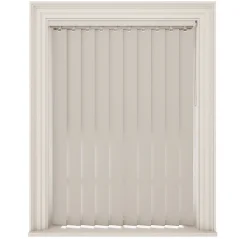
 Vertical blinds have been a staple of UK homes for decades, and for large windows and patio doors, they remain one of the most practical and cost-effective window covering solutions available. Their design — vertical fabric slats suspended from a head rail — makes them inherently suited to wide spans and tall windows in a way that horizontal blinds are not. This guide explains why, and helps you choose the best vertical blind configuration for your specific window or door.
Why Vertical Blinds Suit Large Windows
The fundamental challenge with large windows is weight and span. A wide roller blind requires a heavy-gauge tube and fabric, and very wide roller blinds can sag or operate unevenly if the mechanism is not engineered specifically for the span. Roman blinds in large widths are heavy when raised and can be difficult to operate smoothly. Wide venetian blinds are prone to sagging in the middle slat area.
Vertical blinds avoid these problems by design. Each slat hangs independently from its own carrier in the head rail, and the weight of the fabric is distributed across many individual hanging points rather than concentrated in a single roll or fold. This means vertical blinds can be made in very wide configurations — patio door widths of 240 cm or more — without the structural challenges that affect other blind types at large widths.
Vertical Blinds for Patio Doors
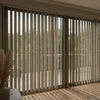
Patio and French doors represent the most common application for vertical blinds in UK homes, and for good reason. A set of vertical blinds across a patio door opening can be drawn fully to one side when the door is in use, cleared completely from the doorway so there is no impediment to access. When the door is closed, the blinds cover the full width, providing privacy and light control.
The key consideration for patio door vertical blinds is the stack direction — which side of the door the blinds draw back to when opened. If your patio door handle and opening mechanism is on the right, you will probably want the blinds to stack to the left when opened, clearing the access side. Split-draw configurations — where the blinds draw to both sides from the centre — are also available and are popular for wider openings where a one-sided stack would be very bulky.
Explore the full range of vertical blinds at 1ClickBlinds, including the slat-only replacement range for existing systems.
Vertical Blinds for Bay Windows
Bay windows present a different challenge. The angled sections of a bay mean that vertical blinds need to be fitted to each individual section separately, with separate head rails and slat sets for each panel. This is generally straightforward for rectangular bay sections where the recess is deep enough to accommodate a head rail.
The meeting points between sections require consideration. If vertical blinds are fitted across the full bay in a single run, the slats at the angle points will not hang perfectly vertical — they will rest against the frame at the corner. For most domestic settings, this is visually acceptable. For a more precise result, fitting separate blinds to each section and using end-cap connectors at the corners gives a more tailored appearance.
Full-Height Vertical Blinds for Tall Windows
Tall windows — floor-to-ceiling glazing panels, full-height living room windows, or high-set bedroom windows — are another application where vertical blinds excel. The slat length can be specified to match any drop, and the head rail is mounted at the top of the window regardless of height. Unlike Roman or roller blinds, where a very tall drop produces a large, heavy stack of fabric when the blind is raised, vertical blinds simply draw to the side when opened, keeping the head rail area compact.
Slat Width and Fabric Options
Standard vertical blind slats are 89 mm wide — this is by far the most common specification and replacement slats are widely available in this width. Wider 127 mm slats are also available and give a bolder, more contemporary look on very large windows. Narrower slats are less common in residential applications.
Fabric options for vertical blinds include woven polyester in a wide range of colours and textures, PVC slats for moisture-resistant applications, and sheer voile panels for maximum light transmission with a degree of privacy. Blackout vertical blind fabrics are available for bedrooms and media rooms requiring light exclusion.
Practical note: When replacing slats, always measure the slat width (89 mm or 127 mm) and the drop length of your existing slats before ordering replacements. Even within the same blind, slat lengths can vary slightly, so cut new slats to match the measured length of existing undamaged slats.
Operating Systems for Vertical Blinds
Vertical blinds can be operated by a cord-and-wand system or by a chain-and-wand system. The cord or chain draws the slats across the head rail to open or close the blind. The wand rotates the carriers, tilting all the slats simultaneously to adjust the angle of light.
Motorised vertical blind systems are available for very large openings or for rooms where remote control operation is preferred. For hard-to-reach patio doors or exceptionally wide window spans, a motorised system significantly reduces the effort of daily operation. Explore motorised options alongside the motorised day and night blinds range at 1ClickBlinds.
Cleaning and Maintaining Vertical Blinds
Vertical blind slats are easier to clean than horizontal blinds of comparable size because each slat can be cleaned individually while still hanging in the track, without needing to remove or disassemble the blind. Dust the slats regularly with a microfibre cloth or a flat duster. For marks or stains, wipe the affected slat with a damp cloth and a mild detergent. If individual slats are damaged or heavily stained, they can be replaced without affecting the rest of the blind — see the vertical blinds slat replacements range for compatible options.