 Skip to content


 Vertical Blinds
 Roman Blinds
 Roller Blinds
 Venetian Blinds
 Day and Night Blinds
 Skylight Blinds
 Children
 Wooden Blinds
 Curtains
 Blinds Accessories
 White
White Yellow
 Gold
Gold Green
Green Grey
Grey Pink
Pink Orange
 Animal
 Floral
 Geometric
 Striped
 Motorized Day and Night Blinds
 Motorized Roller Blinds
 No Drill Rollers
 Perfect Fit Wooden
 Perfect Fit Metal
 Thermal Blinds
 Better Sleep Blinds
 Cordless Blinds
 No Drill Blinds
 Blackout Blinds
 Waterproof Blinds
 Easy Wipe Blinds
 Taped Blinds
 Conservatory
 Office
 Kitchen
 Bathroom
 Dining Room
 Kids Room
 Living Room
 Bedroom
 Bay Window
 Conservatory Window
 Tild and Turn Window
 Bi Fold Window
 Roof of Skylight
 French Door
 Sliding Door
Best Vertical Blinds for Patio and French Doors (2026)
- by Mariam Labadze
 Patio doors and French doors present a window dressing challenge that most other windows simply do not. They are wide, often the full height of the room, and they need to open freely without the blind becoming an obstacle every time someone steps outside. Vertical blinds are the most practical solution the market offers for this application — and they have been for decades, not through inertia but because the format genuinely suits the job. Individual slats that stack neatly to one side when the door is in use, full-height coverage when it is closed, and precise control over light and privacy at any point in between.
This guide covers the best vertical blind options for patio and French doors in 2026, what to look for before ordering, and the questions worth asking before you commit to a particular style or fabric.
[toc]
Why Vertical Blinds Suit Patio and French Doors Better Than the Alternatives
The core problem with dressing a wide door opening is clearance. Curtains work well aesthetically but require a substantial stack-back on either side of the frame when pulled open — on a standard patio door, that can mean losing 30 to 40 centimetres of wall space on each side just to accommodate the fabric. In rooms where the door sits close to a corner or a piece of furniture, that clearance simply is not available.
Roller blinds face a different problem: the fabric rolls up into a headrail at the top of the door. For a standard 2.1 metre door height, a roller blind in a heavy fabric will create a bulky headrail and an awkward transition between blind and open doorway. They also cannot be partially opened from the side — you control only the height, not which part of the door is exposed.
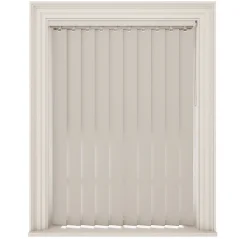
Vertical blinds solve both issues. The slats rotate to control light without needing to be opened at all, and when you do want to open the door fully, the slats traverse to one or both sides of the track, stacking compactly out of the way. A full-width patio door blind with slats stacked to one side typically takes up no more than 15 to 20 centimetres of space — far less than curtains, and with no sacrifice to coverage when closed.
Fabric vs PVC Slats: Which Should You Choose?
Fabric Slats — The Everyday Standard
Fabric slats are the most widely used option and the most versatile. They are available in a wide spectrum of weights, from sheer voile-style fabrics that diffuse light softly without blocking it, through to dense woven materials that offer genuine privacy in daylight. Most fabric slats in a standard weight will give you good daytime privacy while still admitting a pleasant level of natural light — useful for a living room or kitchen diner where a patio door is the main source of light.
Fabric slats are also significantly softer in appearance than PVC. For rooms with a warmer or more considered interior, they integrate far more naturally into the space. The standard slat width for vertical blinds is 89mm, which is the format used in the majority of domestic installations and the basis for most fabric ranges.
PVC Slats — Built for Practicality
PVC slats have a harder, more utilitarian appearance, but they offer advantages that fabric cannot match in certain environments. They are wipe-clean, moisture-resistant and will not absorb cooking smells or steam — which makes them a sensible choice for a kitchen patio door or a bi-fold that opens into a garden room used in all weathers. They are also considerably more resistant to warping, fading and general wear in high-traffic areas.
For most living rooms and bedrooms, fabric is the more appealing choice. For utility-focused spaces where durability and hygiene matter more than aesthetics, PVC is worth considering seriously.
Blackout Slats — For South-Facing Rooms and Bedrooms
If your patio door faces south or west, afternoon sun can make the room uncomfortable and cause glare on screens. Blackout blinds in a vertical slat format use a foam-backed or coated fabric that blocks the vast majority of incoming light when the slats are closed. This does not mean living in darkness — rotating the slats to a partially open position still admits diffused light — but it gives you the option of genuine light control when you need it.
Blackout vertical slats are also the right choice for a bedroom with patio doors or French doors opening onto a garden. The combination of full-height coverage and blackout fabric means you get the same light-blocking performance as a dedicated bedroom blind without needing a separate solution for the door.
Inside or Outside the Recess?
Most patio doors and French doors are fitted flush with or close to the wall surface, which means there is rarely a deep recess to fit within. In practice, the majority of vertical blinds for this application are fitted to the face of the wall or ceiling above the door frame rather than inside any recess.
Face-fixing has a practical advantage: it allows you to extend the blind beyond the width of the door frame on both sides, which ensures the slats stack clear of the door opening when it is in use. A common approach is to fit the track 10 to 15 centimetres wider than the actual door frame on each side, so the stack-back occurs entirely beyond the opening rather than obscuring part of it.
Ceiling-fixing is increasingly popular for patio doors, particularly in rooms with low ceilings or where a seamless wall-to-ceiling look is wanted. The track is fixed directly to the ceiling rather than the wall above the frame, which draws the eye upward and can make a room feel taller. The blind hangs from the ceiling track and sits against the door when closed.
How Wide Can Vertical Blinds Go?
One of the significant practical advantages of vertical blinds for large door openings is their ability to span considerable widths without sagging. Because the load is distributed across multiple individual slats hung from a track rather than a single piece of fabric, there is no central point of stress. A quality track can span well over three metres without needing a mid-point support — which matters for wide bifold door openings or sliding patio doors that extend across most of a wall.
For very wide openings, a split-draw configuration — where the slats traverse from the centre outward to each side rather than all to one side — makes opening and closing significantly easier and distributes the slat weight more evenly across the track.
What to Measure Before You Order
The two measurements that matter most are the width of the track and the drop from the fixing point to the floor. For face-fixed blinds, take the width as the distance you want the track to cover — remembering to include any extension beyond the door frame if you want a full stack-back clearance. For the drop, measure from the ceiling or wall fixing point to approximately 10mm above the floor. Vertical slats that touch the floor collect dust quickly and wear prematurely.
If you have bifold or sliding doors with a bottom guide track on the floor, check whether the slats will clear the guide when the door is in motion. Most standard 89mm slats hang to within a centimetre of the floor and will clear a standard threshold guide without any adjustment.
The Best Vertical Blind for Your Patio Door
For most living rooms and kitchen diners, a mid-weight fabric slat in a neutral or complementary colour to the room is the right starting point — good light diffusion, clean appearance, and practical operation that does not interfere with using the door. For south-facing rooms prone to glare or bedrooms where the door is the main window, move to a blackout-backed fabric. For outdoor rooms, garden rooms, or anywhere that moisture and heavy use are factors, PVC slats earn their place.
Whatever the application, a made-to-measure track fitted to the exact width of your opening will always outperform an off-the-shelf option in both appearance and function. The difference between a blind that fits and one that almost fits is noticeable every single day. Browse the full range of made-to-measure vertical blinds to find the right fabric, slat width and configuration for your door.



)