Skip to content


 Vertical Blinds
 Roman Blinds
 Roller Blinds
 Venetian Blinds
 Day and Night Blinds
 Skylight Blinds
 Children
 Wooden Blinds
 Curtains
 Blinds Accessories
 White
White Yellow
 Gold
Gold Green
Green Grey
Grey Pink
Pink Orange
 Animal
 Floral
 Geometric
 Striped
 Motorized Day and Night Blinds
 Motorized Roller Blinds
 No Drill Rollers
 Perfect Fit Wooden
 Perfect Fit Metal
 Thermal Blinds
 Better Sleep Blinds
 Cordless Blinds
 No Drill Blinds
 Blackout Blinds
 Waterproof Blinds
 Easy Wipe Blinds
 Taped Blinds
 Conservatory
 Office
 Kitchen
 Bathroom
 Dining Room
 Kids Room
 Living Room
 Bedroom
 Bay Window
 Conservatory Window
 Tild and Turn Window
 Bi Fold Window
 Roof of Skylight
 French Door
 Sliding Door
Vision Blinds Explained: How Day and Night Blinds Actually Work
- by Mariam Labadze
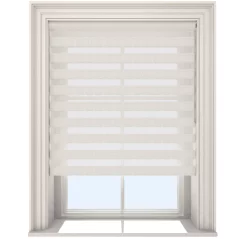
 Vision blinds are a roller blind made from a single fabric printed with alternating sheer and solid horizontal stripes. As you raise or lower the blind slightly, the stripes shift in and out of alignment, so you glide from a clear, light-filled view to full privacy without ever taking the blind off the window. They are also sold as zebra blinds or day and night blinds.
The clever part is that one small movement changes everything. Line up the sheer stripes and daylight streams through while you keep a soft outward view. Nudge the blind so the solid stripes overlap the sheer ones and the fabric closes up for privacy and shade. Vision blinds give you that flexibility on a single, tidy roller, which is why they have become such a popular fit for living rooms and offices. Here is how the mechanism works and where these blinds earn their keep.
[toc]
How vision blinds actually work
Picture two identical layers of striped fabric, one at the front and one at the back, joined so they roll together on the same tube. Each layer has bands of transparent sheer fabric and bands of opaque, light-blocking fabric. When the two sheer sections sit directly over each other, you can see straight through. When you move the blind a few centimetres, the solid bands slide across the sheer ones and the window fabric becomes effectively closed.
That single adjustment is the whole appeal. You are not choosing between open and shut, you are choosing anywhere along a scale of light and privacy. The design is the same idea behind day and night blinds, the term many retailers use interchangeably with vision and zebra blinds. All three names describe the same striped, dual-layer roller.
Why the "day and night" name fits
During the day, most people set the sheer stripes open for a bright room and a gentle view of the garden or street. As the light fades and interior lamps come on, a small shift to the solid bands closes the room off from outside eyes. One blind, handled in seconds, covers both situations. That is the practical logic behind day and night roller blinds, and it is exactly why they suit rooms you use from morning through to evening.
Where vision blinds work best
Living rooms are the natural home for these blinds. You get glare control for the television without plunging the room into gloom, plus privacy the moment you want it. Home offices benefit for the same reason: cut the screen glare in the afternoon, then close up fully for video calls or after dark.
They also sit neatly against most windows because the profile is slim, much like a standard roller. If you like the streamlined look of ordinary roller blinds but want built-in privacy control, vision blinds are the natural upgrade. Kitchens, dining rooms and landings all take them well, though for a bathroom you would want to check the fabric is suitable for a damp room.
Zebra blinds have become especially popular across the UK for contemporary interiors, where the crisp horizontal banding reads as clean and modern. Zebra roller blinds in soft greys and neutrals tend to suit both traditional and modern rooms, while bolder tones make a feature of a large window.
Fitting options: drill, no drill and motorised
Vision blinds fit inside or outside a window recess much like a normal roller. If you would rather not put screws into your frames, whether you rent or simply want a reversible fix, look at no drill blinds that clamp to the window rather than needing wall or frame fixings. No drill day and night blinds are a genuine option, using tension or clip brackets to hold the blind securely without a single hole.
For larger windows, or if you simply like the convenience, motorised versions take the manual chain out of the picture entirely. Motorised day and night blinds let you shift between the sheer and solid alignment by remote or app, which is genuinely useful on tall or hard-to-reach glazing and helps keep cords away from young children.
A note on the control
Most manual vision blinds run on a continuous chain loop. A gentle pull one way lowers the blind and edges the stripes towards privacy; the other way raises it back towards the open, sheer position. Because the adjustment is so small, it is worth taking a moment when you first fit the blind to learn exactly how far to move it for your preferred settings.
Vision blinds versus standard rollers and blackout
It helps to be clear about what these blinds do and do not do. A vision blind is brilliant at balancing light and privacy through the day, but it is not a blackout blind. Even with the solid stripes aligned, the fabric bands are usually dimout rather than fully opaque, and a little light passes through. For a bedroom where you need genuine darkness, a dedicated blackout roller or blind will serve you better.
Against a plain roller, the vision blind wins on flexibility. A standard roller is either up, down or somewhere in between, and when it is down for privacy you lose your view and much of your light. The striped design lets you keep both privacy and daylight at the same time, which a single-layer roller simply cannot do.
Choosing the right vision blind
A few things worth thinking about before you order:
-
Colour and stripe tone. Lighter fabrics keep a room airy and let more daylight through when open; darker fabrics give stronger privacy and a more defined look.
-
Recess or face fit. Inside the recess gives a neat, built-in finish; outside the recess covers more of the window and blocks a little more edge light.
-
Operation. Decide between a manual chain, a no drill fitting or a motorised version depending on the window size, whether you can drill, and who uses the room.
Measure carefully, since the striped effect depends on the two layers aligning correctly, and an accurately sized blind hangs and operates far more smoothly. Most retailers offer a made-to-measure service that cuts the blind to your exact window.
Vision blinds solve a very common problem: how to keep a room bright and open during the day yet private and glare-free when you want it, all from one neat blind. Once you have lived with that flexibility in a living room or office, it is hard to go back to a plain roller.
Frequently asked questions
What are vision blinds?
Vision blinds are dual-layer roller blinds made from fabric with alternating sheer and solid horizontal stripes. By raising or lowering the blind a small amount, you align the sheer or solid bands, moving between a clear view with plenty of daylight and full privacy with shade. They are the same product often sold as zebra or day and night blinds.
Are vision blinds the same as day and night blinds?
Yes, they are the same thing. "Vision blinds", "day and night blinds" and "zebra blinds" are all names for the striped, twin-layer roller that switches between light and privacy. Different retailers simply prefer different terms, but the mechanism and the fabric are identical.
Do vision blinds give privacy at night?
They give good daytime privacy and reasonable evening privacy once the solid stripes are aligned. After dark, though, interior lights make any room more visible from outside, and because the fabric is usually dimout rather than fully opaque, some silhouette may still show. For complete night-time privacy or true darkness, pair them with curtains or choose a blackout blind instead.